Departures is quiet for the morning. The queues through security and immigration are short and there is no longer any need to remove your laptop, tablet or liquids from your bag, before you are deposited into the glitz of the duty free shopping maze.

A brief wander, the impulse purchase of a book, an English translation of a Japanese horror novel. Entry into the temporary Qantas Business Lounge, courtesy of Club membership, paid for in points.
I risk a hot breakfast, after eating so little last night, a stomach churning for days thanks to anxiety. I woke up at 2 am, hungry, nervous, could not fall asleep again for hours until I dreamed of blank white walls. My body clock missed my 6am internal alarm by 15 minutes, but it was not critical.
Get up, use the bathroom. Alex arrives and snuggles us in bed for a short while. He has an exam today. The last guppy has passed, I replace the aquarium pump filter, it refuses to restart, delays in fixing it, then I farewell Alex and join B driving to the station. She has to work in the city, I get off at Wolli Creek, change trains to the international airport.
Now I am here, waiting, trying my best to relax in the lounge.
The Star Alliance Thai A350 that sat outside the panoramic windows has departed, only to be replaced by another. I prefer this temporary lounge to the original. Brighter, more open. Other passengers chat, stare at their phones or just gaze outwards.
The sky is blue and clear right now, aside from some thin cloud towards the city. I hope the same is true when we take off. The fear of turbulence has returned with a vengeance.
Gate 37 is down at the southern end of the terminal. Despite the passengers waiting by the gate, it is quiet. There are views of other aircraft parked at the gate. Jetstar and Qantas Boeing 787s, a VietJet A330, replaced by an Air New Zealand 777.
Our Qantas Airbus A330-300 sits on the other side, the view partially obscured. Boarding is by zone. I am at the front of the economy section, in zone 6, the last to board down the long air bridge.

28A has no window! Just a plastic wall shrinking the shoulder space. How could I have not known when I booked it? My crutch, staring out the window, watching the cloudscapes and ocean, the land?
A young Asian male sits next to me. He asks the cabin crew if the flight is full. It is not. We can move after take-off. The window seat behind is empty. I hope that it will stay that way until it is mine.
The air bridge withdraws, but there is no movement. From the flight deck, Captain Mark Bride, apologises that they found some missing rivets during their walk around, that it must be written up. Then the words of comfort “It should be a smooth flight.”
Hidden away in the audiobooks section of the entertainment menu is music, but the soundtrack selection is woeful, mostly songs from musicals. No matter, I have brought my own.
Listening to music, eyes shut, head against the wall, I try to sleep, half do. At least the windowless intrusion is good for that.
Safety briefing, a taxi to the southern end of the main runway. A turn north and thrust back and the aircraft thrusts forward.
A smooth take-off. The city disappears below. Tiny people going about in tiny vehicles between the tiny buildings shrinking away.
Seat belt light off, we both move quickly. I don’t know where he goes, but the seat behind is mine. 29A is perfect. It has two windows to 28A’s none.
Now Western Sydney is below, the Blue Mountains partially obscured by cloud which builds up until nothing more can be seen but a soft, flat, layer of white.

Bottles of water are handed out. Soon afterwards the crew come through with trolleys of drinks and salty snacks. I choose a Bundaberg ginger beer to go with mine.
Lunch appears, a choice of vegetarian with mushrooms and garlic, Shanghai noodles with beef, or roast chicken and vegetables with a herb sauce, all accompanied by warm focaccia and rice crackers and cheese. The descriptions are repeated in Japanese and I recognise the words.
I choose the chicken. The serving is generous, at least after Jetstar meals. No rush to eat up here. I’m watching South Park season 28 episodes on the entertainment system. It’s been years since I saw any. It’s a distraction and distractions make time go faster.

The path takes us inland of Rockhampton, then out to sea across the Whitsundays. Coral reefs appear through breaks in the cloud, rings of brown in blue.

There are bumps in the air, patterns on the turbulence map, but as we head out into the Coral Sea they settle. Across a rippled surface, over expanses of flat white cloud, the sky above clear and blue, sinking to powder at the horizon.
Most of the windows are closed. I keep mine open a slit to peek out. Approaching Papua New Guinea and there are constant shakes, small, niggling. Two thirds of the journey left to go.
A crew member offers a tray of snacks. The salty crackers, cheese and rice crackers, a TimTam, which is all I take.
Convective cumulus rise above New Guinea, bulbous protrusions reaching upwards out of the white cloudscape that covers the land.

Some lady has complained about my single window shade being partially opened. If you are that sensitive to light then perhaps an eye mask is in order. Maybe I should have brought one from my bountiful unused collection of previous flights when such things were handed out for free. Or airlines should fit high resolution cameras so everyone can look out.
A mountain range of cloud forms a barrier to the north coast of Papua New Guinea, disappearing into the ocean at the land’s edge. There are some further shakes afterwards, but the high cloud lies in wait before the equator.

Though the high cloud disappears, the clear sky feels like a country road with patches of smoothness interrupted by rough sections, as if it were in need of maintenance. This was supposed to be a quieter section. Instead, it is corrugations of convection.
For the next hour, as the aircraft tracks up past the island of Guam, I watch relaxation videos. Then came the water as Kati Thanda floods, a Qantas coastal meditation. Microsleeps.
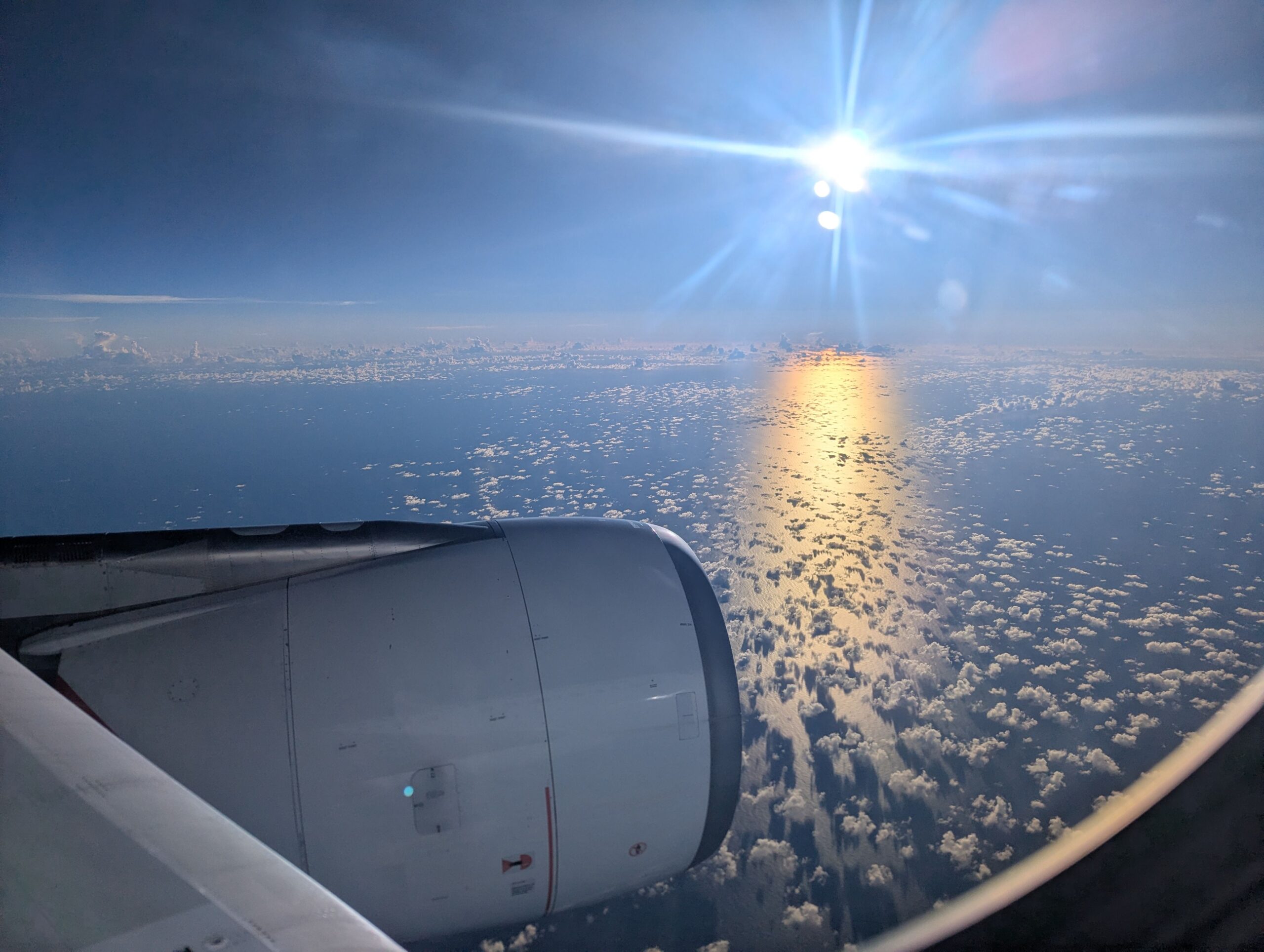
The world outside bumps and sails, scattered clouds drifting over an ocean painted golden by the glade of a gradually sinking sun, lengthening shadows cast across the mirror, the edges of their parent clouds glowing in outline.

Two hours to go and dusky brown-orange skies, like a layer of smog edged with blue above and violet below as the day heads towards its end.

The turbulence map suggests a jump in instability after the minimum. Foreknowledge can bring fear.
Dinner is served, a vegetable lasagna or chicken curry with koshihikari rice, the pronunciation stumping the old Australian cabin manager. Language skills are not the high point of some Qantas staff.
I choose the curry, which is not a particularly good example of the Japanese version of this dish. A creme caramel and warm focaccia complement it.
The threatened turbulence arrives with just over an hour to go, high grey cloud causing the cockpit crew to trigger the seatbelt sign. It is not that bad.
The descent is fairly mild, not as nasty as some into Tokyo. Perhaps air traffic control ask us to delay our entry, for there are many twists and turns, even down to the final approach.
In the darkness the city lights of the Boso and Izu Peninsulas can be seen, depending on our orientation. Fishing vessels, ports and the entrance to the Tokyo Bay Aqua Line underwater highway tunnel can all be spotted on the final descent.

Haneda itself looks huge, with grander terminal buildings than Narita and other Japanese airports. We taxi to a far gate, the disembark quickly.

I leave my thin jumper on board.
To reach immigration means traversing many travelators, dodging elderly Australians. The immigration process is quick, far faster than our last entry to Japan.
JR East do not make their rail pass collection easy for those on later flights. Terminal 3’s travel centre closed at 8pm. I use the private Keikyu Line to ride to Terminal 3, take a long walk up to the tourist centre there, which closes at 10 pm.
Pass collected, the Tokyo Monorail takes me into the city. The incongruously snow themed interior, it is almost summer here, is crowded. The terminus is Hamamatsucho, where I change to the Yamanote Line to Tokyo Station.

A walk from the Yaesu exit to the remm hotel Tokyo Kyobashi. The interior is brighter than its Shin-Osaka version, compact, but modern. A rain shower to wash away the perspiration of long distance travel, the massage chair to knead away tension in the back and ankles.

A late night supper from the konbini downstairs, a simple Bento. Despite the exhaustion, sleep comes slowly, is disturbed. I will rest on the trains tomorrow.