Back in early 2011 we were planning an April trip to Japan and part of the plans included catching trains along the Sanriku Coast in the Tohoku region of north eastern Japan. Then the terrible earthquake and tsunami hit in March. The names of many of the towns devastated by the tsunami were part of those plans.
And so the Sanriku Region has been unexplored by us until today. Well, by us, it’s just me now. The other two had a somewhat unpleasantly bumpy and delayed flight back to Cairns overnight. They, and the other Sydney passengers, were given priority in exiting the plane and going through security, but still had to wait for their bags. Jetstar held the Sydney flight for the 20 or so affected passengers and they eventually made it home.

I wake up at around 6 am, get ready for the first Hikari Express to Tokyo, buy sandwiches for breakfast from a convenience store at the station. The Shinkansen is a N700S, the most recent type on the Tokaido services.


It is a beautiful crystal clear day as we head out and 0 degrees Celsius. There is snow in the mountain tops and signs it has recently snowed in Kyoto, but Maibara is still mostly clear.
Unfortunately, as we approach the Fuji region, the weather turns. On the first day I’m sitting on the left low cloud has covered the mountains and obscured Mount Fuji!


I have half an hour in Tokyo before my Hayabusa to Morioka. Finding the right platform eats up some of that time and I end up just buying an ekiben from the platform stall. I choose a self-heating chicken bento. I’ve had a beef (not beef tongue) one before and it’s pretty cool. The other choices were a bit boring anyway.
The shiny green Hayabusa Shinkansen service pulls up at the platform. I’m too far back to see the connection with the red Akita service. The carriage is packed, so I’m glad I booked my window seat in advance. An older Hong Kong couple seem to be confused that they can’t just choose their own seats together and cause a bit of havoc throughout the trip with their luggage and going up and down.

We head out via Ueno and Omiya, then split off to the north. Initially the land is mostly clear of snow, except in the mountain ranges that form the long spine of the island. But around Koriyama there is snowfall outside. Then it’s clear outside. This repeats a couple of times.


There is a trolley service on this Shinkansen, so I order another ice cream as dessert for my ekiben. At midday I heat it up and, though not scorching hot, it is certainly warm. Also delicious. The chicken is really tender. I would buy it again.


The train clears at Sendai. I change into my snow boots in preparation for the next leg.
I have a limited transfer time in Morioka. I’m worried. The JR East website warns that the Yamada Line, amongst others, will experience heavy snowfall and may be delayed or closed at any time.
After the tsunami, parts of the Sanriku coastal line were closed and converted to Bus Rapid Transit routes. The rebuilt railway section was transferred to a “third-party” railway. The line is reached from the Tohoku Shinkansen route and other parts of the JR system by a number of lines radiating out of Sendai, Ichinoseki, Morioka and Aomori.
I tried to work out an itinerary that would include most of the and the entire extent of the Sanriku and east coast north of Tokyo. I mostly succeeded, but then another earthquake hit, knocking out a part of the line between Kuji and Aomori.
That was a chance to reevaluate my plans. The time spent on trains was insane with almost no chance to do anything else. I knew I’d end up tired and unhappy, just an exercise in box ticking.
So I looked at what routes I felt were most likely to close. There’s a private line in Hirosaki that is already scheduled to finish. Then there is the Yamada Line.
Already many services are operated by buses. It would only take a natural disaster, very frequent in Japan, and it might be closed forever.
So here I am, hoping that snow won’t stop me.
After a false start, I find the pair of green and cream KiHa 110s at platform 2. It appears to be getting ready to run. There are passengers inside, where it is nice and warm. There are two seat benches facing each other on the left of the train, single on the other.


This is a Rias Rapid Service to Miyako. With a growl of the engines we start out only about 10 minutes late. Outside the canopy of the station, the landscape is coved with snow.
The first couple of stops are for locals, of whom there are many. Trudging out on to narrow snowy platforms off to do whatever they do.
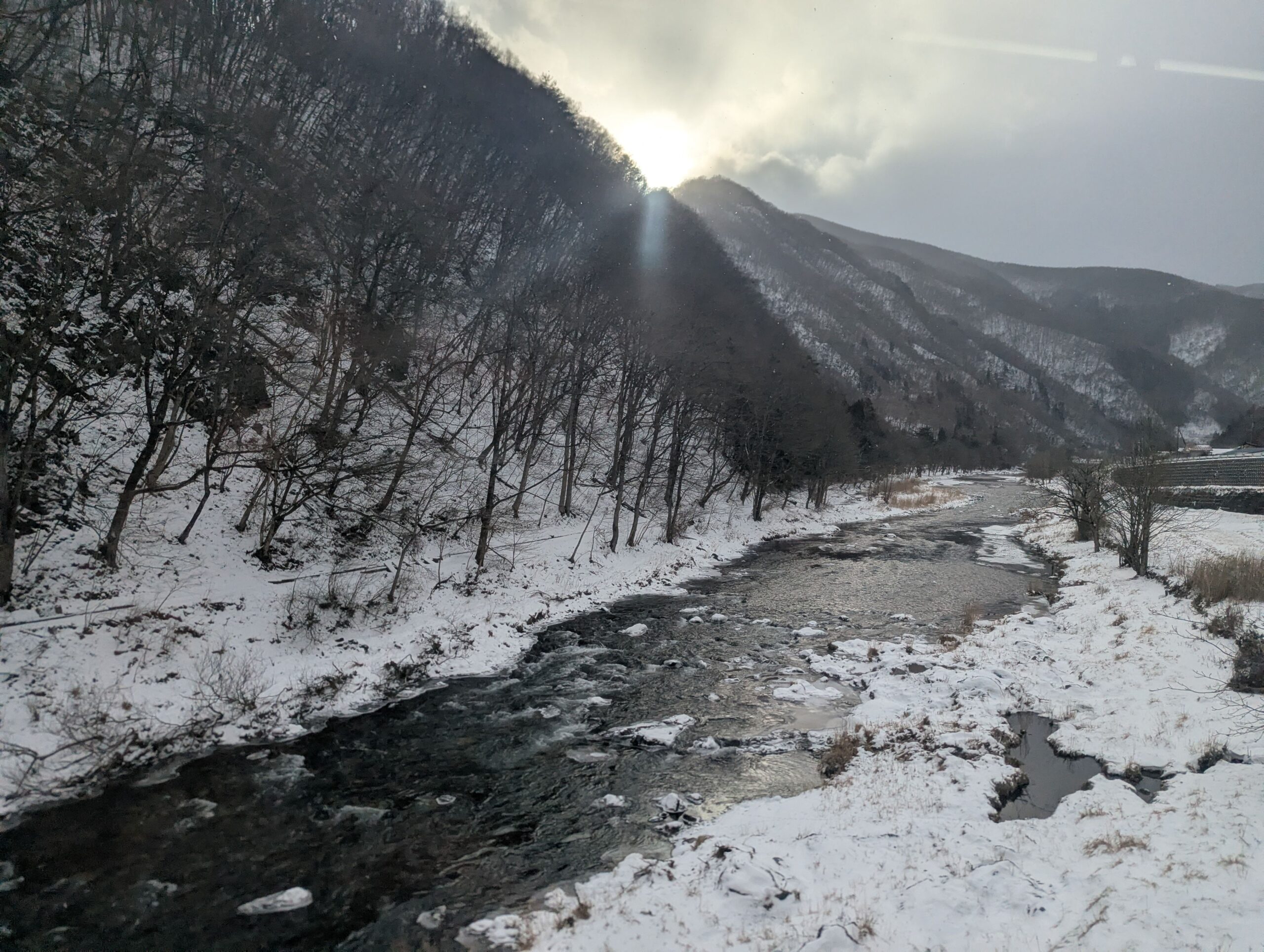
Then we leave greater Morioka for the more sparsely populated lands between the city and the coast. Initially the line follows the Yonai River, weaving around it left and right. We are rising and it sounds like the engine is labouring, but the scenery is wonderful. Clear black water in the river against clumps of snow on bare trees and evergreen cedars. The blue sky above highlights the tall mountains on each side of the valley.
There are often steep banks to one side of the train and I can see hazardous fallen trees and boulders marked in pink, possibly to signify future removal.
Up and up we go until it feels like we are running near the tops of the mountains themselves.
We pass through a long tunnel and then I can feel the train beginning to descend. Snow flurries blow outside and you can hear clumps of snow and ice falling on or off the train.
Now we follow the Hei River, almost all the way to the coast. The closer we get the less snow. After two and a quarter hours we finally reach the terminus of Miyako.


I have roughly half an hour to kill in Miyako. Enough time to browse the interesting Sanriku railway shop, full of local produce and railway themed items. I also visit a quaint little patisserie Lait de chevre, where they specialise in goats milk products. The proprietor recommends their cream puff, which indeed turns out to be moreish thanks to its slightly savoury addition of toasted sesame seeds.

The Yamada Line to Kamaishi was part of the route transferred to the Sanriku Railway. I need to buy a separate ticket for this, as my JR Pass doesn’t cover it. I am given a sheet of paper with holes punched for the date, the start and finish stations and the amount paid.
The route initially begins in the mountains, but then periodically approaches the coast. Sadly darkness is starting to fall and I am on the wrong side of the busy train for the best of the views, but the ocean is mostly hidden by the basic concrete walls protecting the coast against further tsunamis.

The tsunami height at Miyako was recorded as over 40 metres, an incredible height and I suspect still taller than these barriers.
Where rivers flow out to sea, flood gates wait, ready to shut if a tsunami comes. Eventually I get a seat on the left and, if it were lighter, there would be spectacular views of the bays and rocky headlands as we go up and over the ridges. Despite the view, I struggle to stay awake, the droning of the diesel engines sending me into constant microsleeps.


The train terminates in Kamaishi and I am glad that I am finished riding trains for the day.


I love the fact that my hotel, the JR owned Kamaishi Folkloro, is adjacent to the train station. The room may not be special compared to the past two hotels, but it’s perfect for what I need.

One downside is that there are no open eateries around the station and I am in no mood to trudge off into the centre of Kamaishi. Fortunately, there’s a Lawson konbini, so once I drop my bags off I head there to get some premade dinner and salad. It’s enough.

Also, the hotel has an indoor and outdoor public bath. Fairly plain ones, but quiet. Just what I need after a long day.
I also need to use the laundry. I hope the dryer is good, because I don’t feel like staying up late tonight. Tomorrow is another early start, though one where I suspect plans will change due to the snow.