What is the most efficient method to traverse a network, to minimise the repeated nodes and the edges that connect them? This is a surprisingly difficult answer for all but the simplest cases.
Now add constraints. Like time. And times. The algorithms become even more complex.
To ride the entire railway network in Japan is an impossible dream. So we must simplify the network, take a subset.
Sometimes we must do so before others do it for us. Permanently.
Faced with massive financial losses, on the 26th of March the third-sector Heisei Chikuhou Railway resolved to replace its three railway lines with buses, delivering an urgency to ride their rails.
A view of the map suggests that most of region is reasonably serviced by other, mainly JR, lines. It is this fact that allows the building of an interesting itinerary that avoids the need to backtrack across the same route, with one exception.

Kokura to Yukuhashi: Nippo Line Sonic Express
The grey metallic shell of the JR Kyushu 787 Series looks like a brutal robot on rails. The futuristic black and grey interior only reinforces that impression, though the comfort belies that humans were involved in its design. JR Kyushu has the most interesting fleet in Japan when it comes to design.

After meticulous planning, I woke early and made all the times null an void. This isn’t the Seagaia service, but the one to Miyazaki Airport, in the one of two as yet untraversed prefectures. I am almost tempted to stay on board, but no, I get off at Yukuhashi.
On the opposite side of the platform is the Seven Stars Kyushu luxury rail cruise train. I do not think I dress appropriately enough for such refined gunzelling.

Yukuhashi to Nogata: Heisei Chikuho Tetsudo
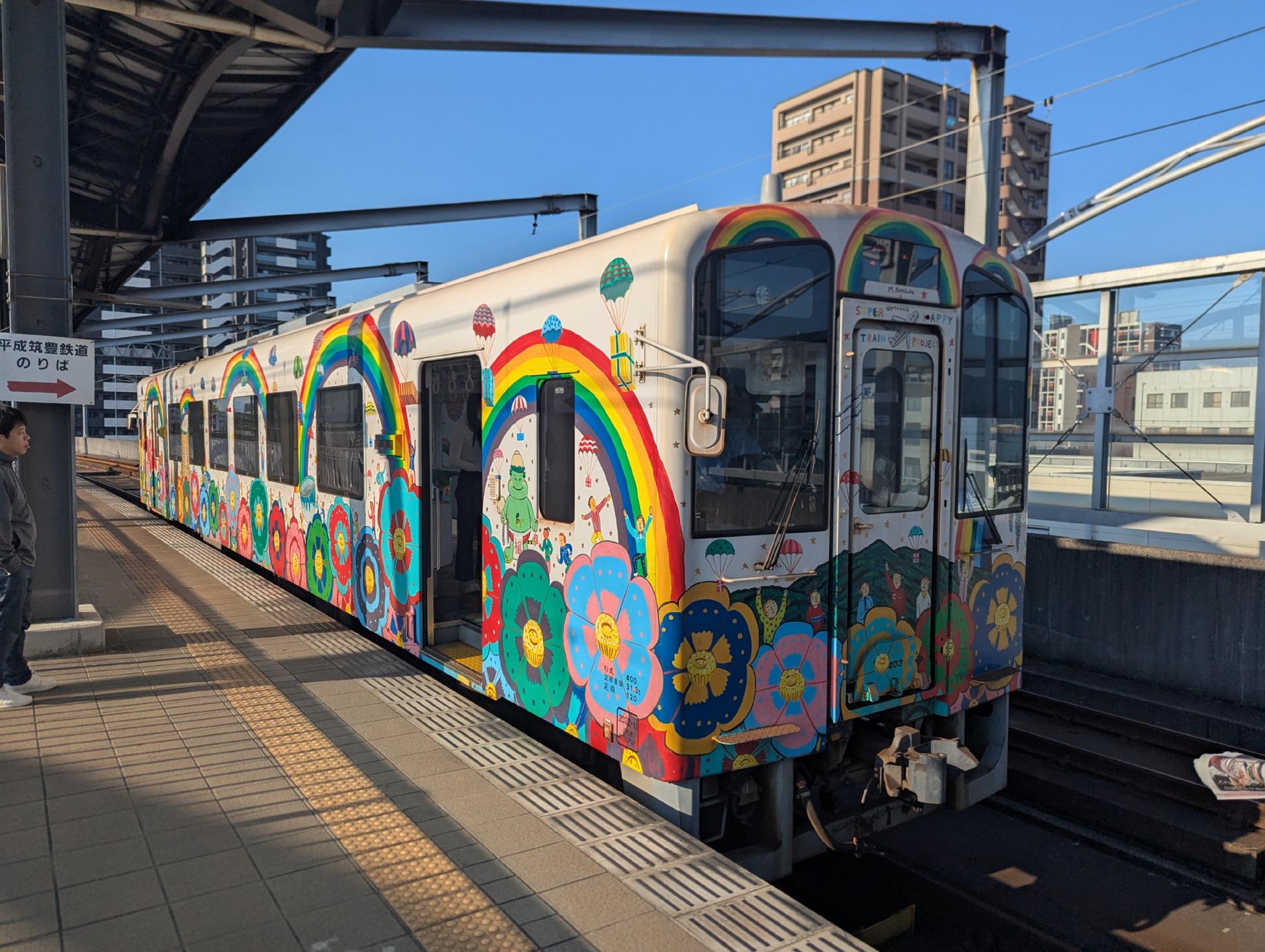
In contrast to the seven conservative dark green carriages and one diesel locomotive of the Seven Stars, there is just one railmotor car that rolls up to the Yukuhashi terminus of the Heichiku Railway, and it is a riot of brightly painted flowers and rainbows like some primary school art project.

They are all over the interior too!
I stand at the front, the imaginary train driver. A few passengers are seated behind in the colour, comfortable, interior.
This train traverses the two major Heichiku lines, the Tagawa section from Yukuhashi to Tagawa Ita, and the Ita Line to Nogata. The Tagawa Line is a single track with passing loops through primarily rural areas. It begins in flat plains where rice paddies mirror the clear morning skies.
Passengers get on and off the isolated platforms. Primarily elderly or school students in uniform.
As we head further into the interior of Kyushu, the track begins to climb into the summer vine covered jungle of the hills and mountains. Though not as dramatic as passing through the mountains of Honshu or along the rocky coast of Tohoku, there is a real beauty here, a sense of being up close and personal with the landscape as we trundle along.

Now and then, at stations with loops, other trains pass us in the opposite direction, including one rail motor advertising Maxell, like the cassettes we used to record on to.
At the station of Magarikane, two trains meet and a huge crowd of school students leave to begin a trek to their high school. Seeing this, it is difficult to believe that the line could be underpatronised.

Tagawa Ita is a junction between two Heichiku lines and JR. We wait for a while, the driver goes out and gets a drink from the station vending machine, then the train continues.
The Ita Line is double tracked, lacking the intimacy of its predecessor, and passes through a flatter and more urbanised region. There are still rice paddies, rivers and a backdrop of mountains, but also many more houses. The train itself is busy with passengers coming and going along the line.
Chikuho-Nogata to Kurosaki-Ekimae: Chikuho Electric Railway
The terminus of Nogata is served both by Heichiku and JR trains. A fifteen minute walk away is Chikuho-Nogata, operated by Chikuho Electric Railway, or Chikutetsu. It’s already quite hot outside. Ignoring hunger and heat, I walk quickly, discover that the station is elevated.

The Chikutetsu originally included a tram service and their vehicles are still trams. This is more of a light rail line as it does not run through any streets, passing through both semi-rural and urban sections, rice paddies and shopping centres.
Crowded, due to the small cabins, the tram quickly fills with a variety of passengers. The ride is very shaky, with much side to side oscillation, but nobody seems to fall over.

The Kurosaki-Ekimae terminus is in Kurosaki city, the concrete adjacent to the JR Station. On the way between the two I stop at a bakery, the only concession to my rumbling stomach.
Kurosaki to Nogata: JR Kagoshima and Fukuhokuyutaka Lines
For the return trip to Nogata, the tram is replaced with a modern CT 821 electric train. Once away from Kurosaki, it follows a more rural route along the edges of developed areas, over rivers, past fields of rice. There are not too many variations in crops around here.

Nogata to Shin-Iizuka: JR Fukuhokuyutaka Line
Change to a CT 813 electric train, a bit older. The line is a continuation in both track and landscape. It’s not unpleasant, just not particularly remarkable, a transit rather than a destination in itself.

Shin-Iizuka to Tagawa-Gotoji: JR Gotoji Line
Shin-Iizuka is the junction where the Gotoji Line meets the continuing Fukuhokuyutaka Line. Alex brought a video of the Gotoji Line to my attention, with the line’s Funao Station being dubbed “Japan’s dustiest”.
The single-track line is serviced by white and blue-striped JR KiHa 40/47 diesel railmotors, ancient but very popular vehicles that stand in stark contrast to the very modern JR Kyushu fleet. Unlike other versions such as those with JR West, the KiHa 40s feel old and worn, even down to the padding in the seats. This only serves to increase the excitement of riding it.

A single KiHa 40 railmotor is doing the honours today.
The Gotoji Line runs through populated areas, then up into the mountains, up through the jungle, past the recreational area around Iiyama Pond. It feels like an adventure.
Winding through the mountains we come to the big limestone mine and Aso cement plant at Funao Station, which exists to serve them. Nobody boards or disembarks, so our stay is brief and dust free.

A few kilometres later and we reach the terminus of Tagawa-Gotoji, joining other KiHa rail motors, their plan scheme offset by the colourful flower garden planted between the tracks. A change of platform is required.
Tagawa-Gotoji to Kanada: Heisei Chikuho Tetsudo
The Itoda Line is the shortest section of the Heichiku Railway, running between Tagawa-Gotoji and connecting to the Ita Line at Kanada (wonder if they have any maples there?). Waiting at Tagawa-Gotoji is the Maxell cassette rail motor spotted earlier.

The interior is far less retro than the just ridden KiHa 40, but I find myself rewinding the journey by standing at the rear of the train. More semi-rural scenery and local lives.
The Itoda Line is joined by the two Ita Lines as it approaches Kanada.
Kanada to Tagawa-Gotoji: Heisei Chikuho Tetsudo
The original plan gave me the option of either repeating the Ita Line or the Itoda Line, but now the fastest was the latter. Surprisingly, it meant departing from platform 1 and crossing at the tracks. Meanwhile Maxell heads off for stabling and a regular yellow rail motor replaced it for the return ride to Tagawa-Gotoji.

Tagawa-Gotoji to Shiikoen: JR Hitahikosan Line
The ends of the coupled KiHa 47 pair of railmotors is stained with dust and dirt. Ceilings fans supplement the air-conditioning, rotating to face all sides of the carriage.

It is a relief to sit in the straight backed bench after standing for so long, to stare out the grimy window. This is a mainly rural line, through the ranges and forest, bamboo and rice paddies, villages and a limestone mine.
The landscape is not grand and dramatic, the train is not luxury, but I realise how much I miss this in Australia. This is the train ride I dream of in many guises. Slow trains that connect you with the world outside, that take you from nowhere to nowhere else.

Suddenly I remember where it started. I was about 15 years old, on a holiday with family in Adelaide. I went travelling by myself one day, caught a Red Hen railmotor up the Adelaide Hills to Belair. On that hot summers day, listening to music on a portable tape player as we rose high into the hills through dry bushland, it was magical. I don’t think I’ve ever got over it.
The Hitahikosan Line runs all the way to Kokura Station, but there is one final deviation to be performed as I disembark at Shiikoen, hidden away in a cutting before a road bridge.
Kikugaoka to Kokura: Kitakyushu Monorail
A short walk away is the Kikugaoka terminus of the Kitakyushu Monorail. Beyond it, the track curves away into the service centre. From the top, the snake-like track switcher can be observed switching as each train arrives and departs.

The straddle type monorail gives riders amazing views from high above Kokura as it twists its way down from the hills and past residential and commercial areas, past the Kitakyushu University and the central shopping district.
When the monorail pulls into Kokura Station, it completes the loop. Ten legs, (neglecting walks), only one repeated. Worth it? Absolutely!

I suspect the residents will mourn the loss of their trains. They were cheerful, well maintained and, from my observation, well patronised.
Mojiko
The original plan was to arrive back at around 4:30pm and spend the evening exploring and resting after two late nights and another one to follow. But I am two hours early! Enough time to visit Mojiko and the railway museum there, though unfortunately too late to take the final Heichiku Line, a short tourist train from Mojiko to Moji Harbour that will likely survive the closure.
A commuter train runs around the coast to Mojiko, past warehouses and factories, outrunning a small container ship sailing through the Kanmon Strait that separates Kyushu from the main island of Honshu. Mojiko Station was once the railway gateway to Kyushu before the construction of the Kanmon tunnel between the islands and its status is reflected in the grand architecture of the station building. For this alone it is worth a visit by any rail enthusiast.

The nearby Kyushu Railway History Museum celebrates the heritage of the island’s railways. The entrance leads past a series of static trains on display, steam engines 59614 and C59, electric locomotives EF10 and ED72, the beautiful red and cream KiHa 07 wooden rail motor, a couple of retro express locomotives and a blue sleeping car which you can try out, sans shoes.

The main building has two floors of mainly static exhibits, a train simulator and a HO scale model railway diorama where you can control a train for 100 yen. If they are not about to run a show, which they were, showing off some of the major, and attractive, express trains from around Kyushu.
The layout is smaller than others in Nagoya, Kyoto and Tokyo, the same being true of the rest of the museum. I didn’t spend too much time with the exhibits which were mostly in Japanese. There was no ticket gate exhibit, making it not a museum of interest to Alex. The museum shop was extensive, with many cool railway goods. I spent some money there, also purchased a gatchapon for Alex with a station sound gift inside.

Outside there is a miniature train park for kids to ride around a track in small recreations of Kyushu trains and three historic train cabins to imagine that you are a driver.
Mojiko has many historic buildings from around the end of the 19th and the early 20th centuries, clustered around the port area. Very trendy again now. With no food since that bakery brunch, I am hungry, wander the area, but it all looks western, slow and expensive, so I return to the station.
It really feels like this should be the start of a luxury journey across Kyushu, but there are only a variety of JR Kyushu commuter trains coming and going. I catch one and return to Kokura.
Minamihakata
In January we rode the Shinkansen to the tiny snow resort branch of Echigo-Yuzawa. Two stops remain to complete the existing network. Nagasaki’s disconnected Shinkansen line will need to wait for another day, but Alex discovered another tiny branch to Minamihakata (South Hakata). It leads down to a storage depot as a branch from the Kagoshima Line, but has its own station. There is no reason to visit it other than completeness, so let’s do that while alone.
The line is not actually sold as a Shinkansen, but a regular express operated by some Kodama Shinkansen trains after Hakata. One is located on return from Mojiko, but there is enough time to shove down a bowl of kakiage udon from a stand-up stall in Kokura Station. It isn’t very tasty, but it is the first real Japanese hot meal I have eaten since arriving in the country.
The Kodama Shinkansen is an old Hikari RailStar. In the grey light it rides one stop to Hakata, where most passengers leave, to be replaced by a surprisingly large crowd heading to Minamihakata.

One stop away, it follows the elevated Kagoshima Shinkansen Line, until it switches tracks and heads down to ground level. There, most of the crowd leave, but not all. Densha otaku are rarely alone in Japan.

This train returns as far as Hakata, then it is necessary to change trains. The JR Pass does not allow use of Nozomi or Mizuho services without payment of a supplement, so there is a wait for a Sakura. I think of a Hakata tonkotsu ramen while here, but no outlets are apparent in the Shinkansen area and there is a desire to return a bit early.
The Sakura service pulls up and we return one stop to Kokura. It is not yet 8 pm, so I hurry across from Kokura Station to the SAINTCity shopping mall, buy coloured pens at Loft, undergarments for others at GU. Video the curved escalators at the food level, decide Sushiro is too busy, head down as the shopping centre closes for the night.
Dinner is Jiro ramen at a restaurant beneath the station. My breath now smells of garlic.
By the time the washing is finished it is midnight, but I have achieved more than I expected on a very long day of 15 trains.