Yesterday we caught a maglev. It ran a lot slower than this Shinkansen, but in future this route is supposed to be on one. For now, it’s just Linimo or the test track in Yamanishi.
The SC Maglev and Railway Museum in Nagoya is about the latter service. SC stands for superconducting, where the materials in the train are cooled to near absolute zero and lose all electrical resistance. This allows them to conduct very high currents without the loss of energy and generate extremely strong electromagnetic fields.
We catch a regular Aonami commuter service to the terminus at Kinjofuto Station. This is Nagoya’s port district and there are fantastic views of the Meiko Higashi Bridge, the car loading ships and the Nippon Steel Nagoya Works.

On the other side of the tracks is Legoland Nagoya, which we visited previously. This is our second visit to the railway museum. It was this one that sent Alex wild about them, all because of the electronic ticket gate.
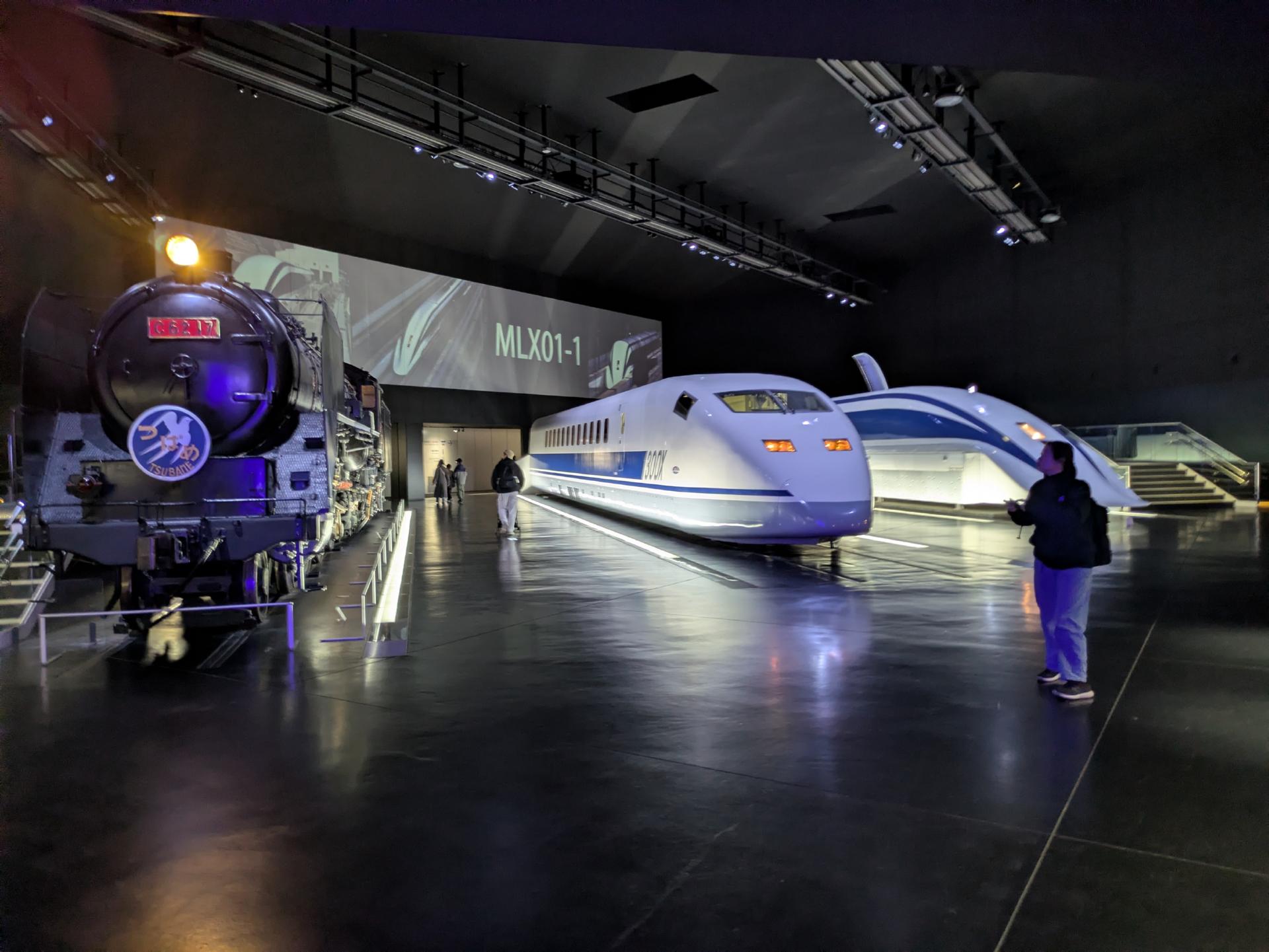
After entry is a hall containing Japan’s fastest steam locomotive, C6217, the 300X test Shinkansen and MLX01-1, a maglev test locomotive.

Following that is an even larger hall with many JR Central and Tokaido Shinkansen and passenger locomotives and cars from across the ages on display. These included the 0, 100, 300 and 700 Series Tokaido Shinkansen and a number of express trains from the pre-Shinkansen era.


There’s a real sense of how trains have changed over time. I particularly enjoy comparing the retro dining cars of the 0 Series and double decker 100 Series dining cars, the Japanese-Western menu. Today, even the cart service has ceased on the Tokaido Shinkansen. Then I see the old wooden interiors and are transported back into a historic Ghibli movie. One even has a steam engine built in, an early version of a rail bus.


Pride of place is taken by the recently retired Doctor Yellow track checking Shinkansen. It has a small yellow torii placed in front and a place to write messages of appreciation, like prayers at a shrine.

I can’t think of any other place in the world where a track maintenance machine would be so loved.
To the side of the trains are hands-on displays demonstrating various principles of Shinkansen operation, including automatic train control and stopping services when an earthquake is detected (the S and P waves propagate at different speeds, allowing a pre-warning of an impending earthquake, triggering a power shutdown).

The reason we are here is the old Shinkansen ticket vending machine and automatic ticket gate. Alex has grown up a bit since the initial visit, so there aren’t a zillion tickets printed and used, but he does have a long play with it.

On the other side of the hall is a room showing how maglevs work. Japan has been developing the technology since the 70’s, with test vehicles undergoing a number of variations, from something out of the Jetsons to the current iteration. There’s also a simulation which demonstrates how it would look riding at 500 km/h.


Japan’s largest railway diorama takes up another room, showing the Tokaido route from Osaka to Tokyo, with Nagoya at the centre. There are regional lines as well and a huge variety of trains on display, including the maglev.
A compressed day shows services running between cities and towns, a rock concert, baseball match, and ambulance and fire engine riding to the rescue and ships on the harbour. In the middle of the night the only trains running are track maintenance vehicles and the Seto Sunrise service, Japan’s only remaining regular sleeper train. There is always something going on!


It is then time to ride on the real thing. We catch the Aonami Line back to Nagoya, have some local fried chicken dishes for lunch, collect our luggage, and board the Tokaido Shinkansen for Tokyo.


Alex wakes me up just in time to see a magnificent view of Mount Fuji, only the summit touched by cloud, the snows short and the mountain mostly bare.

Once at Tokyo Station, we change to the Yamanote Line for our short trip to Akihabara. Then we have to get out of the station.

Shinjuku is a maze, Akihabara is a nightmare of orientation. I prefer the former. Akihabara is full of clueless gaikokujin, including ourselves, and multiple levels and directions of tracks. It takes me a while to orient myself.

Alex doesn’t understand.
“Why don’t you just use Google Maps?”
I like to know where I am in a spatial sense, where I’m facing, to build a mental picture of my location. I study the map and count the number of cross streets until we turn, where the hotel is, so I don’t need to keep staring at my phone. It works.
The MONdays Premium Apart Hotel Akihabara is a bit inconveniently located (especially as our last stay in the suburb was in a hotel forming part of the station building) and it’s a pain needing to enter six digit numbers just to enter the lift and another to open the door to the room. But at least there’s a washing machine in the room. And cooking facilities, should we need them.
We don’t tonight. Alex has decided that he wants to go to the Kura Sushi Global Flagship Store in Asakusa. The fastest way is via the Tsukuba Express service, an underground metro train that takes us two stations to Asakusa.
There’s a long wait for a table at the very modern, very wooden Kura Sushi located on the fourth floor of the ROX building. Many restaurants have stopped serving sushi via a conveyor belt, but there are two in operation here. The regular train service runs dishes around in a loop. The Shinkansen-like express service shoots out your order, made using a tablet, right to your table.

When you are finished with your plate, you insert it into a slot at the side of the table. Every five plates earns you a chance to win a gatchapon. Only one of our attempts is successful and we get a roll of washi tap in the plastic egg that drops from above.

The basic conveyor belt plates are 150 yen each, I think 320 yen was our most expensive order. According to the others, the sashimi wasn’t the best, but I enjoyed the less traditional gunkan and nigiri sushi I ordered, including the tempura cheese that was so good that I ordered it twice. The overall bill for 22 plates was under A$45, an amazing deal for three.

We wander through the ROX building. I pick up a portable cassette player with Bluetooth for about $15 from the 3 Cents shop. I’ve still got cassettes, now I have something to listen to the on, I guess. I don’t know why I’d want to, considering I have almost my entire collection now on digital or CD.
Returning to Akihabara, we go to the giant Yodobashi to look for a laptop case for Alex. We end up buying a couple of ergonomic mice and some pens as well. They others have to pull me out of the model railway section, as the store is closing at 10 pm. If only I had space for the railway museum railway layout…