In Australia we say that it’s the beginning of 2026. In Japan, it just ticked over to Reiwa 8. That’s because they measure years from the beginning of the reign of serving emperor. It’s very confusing to non-Japanese. Why is this important? More later.
Our more immediate concern is the time of the clock. Or avoiding looking at it too hard. It was nice to sleep in, but we do want to visit the Miyagawa morning market. First, however, we take the time to watch the snowflakes drift down into the little garden outside our room. Now and then they are punctuated by clumps of snow falling off the roof.

We pack our stuff and sadly check out of the hotel, leaving our bags with the desk. Then we trudge out into the snow, more falling on us as we walk into the centre of Takayama.

The market is on the other side of the Miyagawa River. It is difficult to believe that on our last visit to Takayama we were splashing our feet in the summer water and watching the willows wave in the wind. Today, the willows are bare of leaf and coated with snow, the river off limits.


There are few stalls open above the river bank, most are established shops. I buy a Hida beef bun, the others a cup of miso, pork and vegetable soup from a tent. Warming, nourishing food in the cold. As we walk along we get dried fruits and sesame biscuits, packs of the local miso, darker and richer than most elsewhere in Japan.
Walking back, we stop to get crackers and skewers of Hida beef.

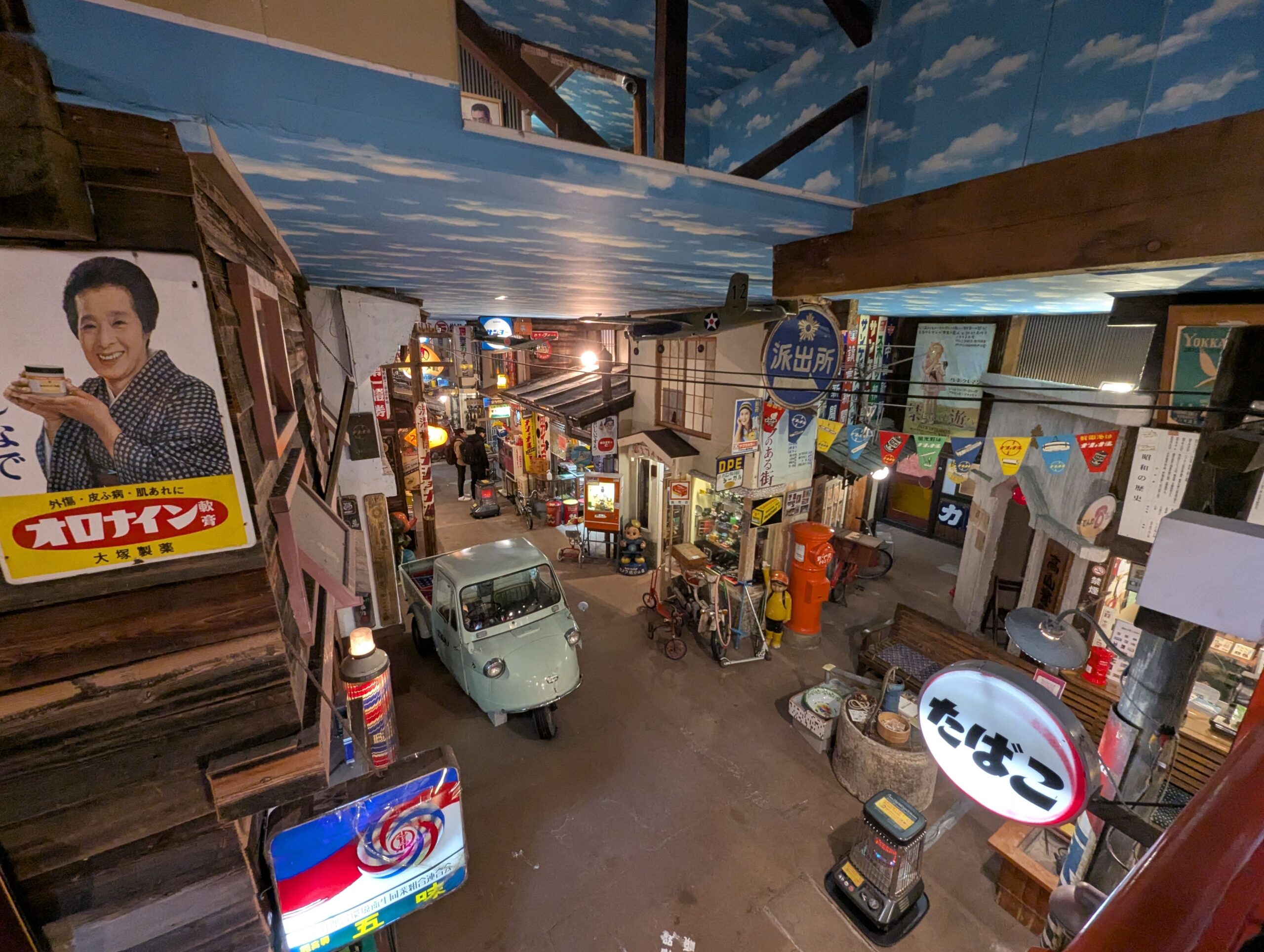
It was B’s birthday on our last visit to Takayama. We bought a delicious strawberry cream cake from Monbille, sadly closed today. Opposite it was the Showkan Museum. I really enjoyed the museum, but the others didn’t join. Today, I want to show them Showa.
The Showa Era corresponds to the reign of Emperor Hirohito, a period which spanned prewar Japan in 1926 to the beginning of 1989. That stretches from before my parents were born until well into our formative years.
This indoor museum is decorated as town streets with small shops containing items from across the era, most of them in the post World War II era, the 60’s until the 80’s. There is a tiny restaurant, a hairdresser, a doctor, a camera shop, one selling sundry items, another toys. An old house, a school room with a Snoopy typewriter and a working Casio organ.


There are many items from my childhood and ones I dreamed of owning. A working arcade and an old game console, some fascinating electronics, cassette players, turntables. Televisions showing old programs, working slot, pachinko and pinball machines. Alex and I play air hockey against each other on a slightly warped table.
Although it’s before his time, Alex has an appreciation of the era and we spend a long time inside.
There’s not much time left to explore the historic town centre, though fortunately we’ve done that plenty of times before. The sun is out and the old wooden buildings look a bit less atmospheric in the slushy melting snow.

We buy mitarishi dango from the little stall before the bridge, as I have done so many times before. I want to eat Hoba miso, beef and mountain vegetables grilled on a Magnolia leaf, but there isn’t time to find a place. Instead we order beef on rice and Takayama ramen from a store on the corner near the bridge. You can taste the Hida beef in the ramen stock, it’s different, rich and delicious. Perfect food for this weather.

It’s snowing again as we make our way back to the hotel, collect our luggage and return to the station. The train is delayed, so we have a fair wait on the platform.

Unfortunately we are on the same side of the train as on the way up. The view is different in the afternoon snow. You can tell it’s been heavy in some areas, much lighter in others. The late afternoon lights turns golden, the river takes on a dreamy appearance.


The sun sets behind the mountain range as we approach Gifu, then there is an evening cityscape entering the city. Pulling into Nagoya, I spot our hotel.
Our room is much smaller than the one we just stayed in, barely squeezing in the extra sofa bed. There is central heating, but luckily there’s an outdoor vent built into the window.
We change out of our snow shoes and return downstairs to find dinner. There is a lot of construction going on around Nagoya Station, for the maglev according to Alex. B wants to go to Futaba miso tonkatsu in the ESTA underground shopping area in front of the station.
The tonkatsu is very tender, the miso sauce sweet. We end up sharing our dishes. Then we recharge our IC cards and explore the Takashimaya department store connected to Nagoya Station. Actually, we just go to the much cheaper Hands variety store section and end up buying a few things, hand cream, a ladle, regional bath salts. I recognise the kanji for Gero after we passed it twice in the train.

Although shops usually close before 6 PM in Sydney, 8 PM seems too early for Japan, so we have to hurry out. Then we make our way back to the hotel, via a konbini as usual. At least it’s not to buy dinner this time.