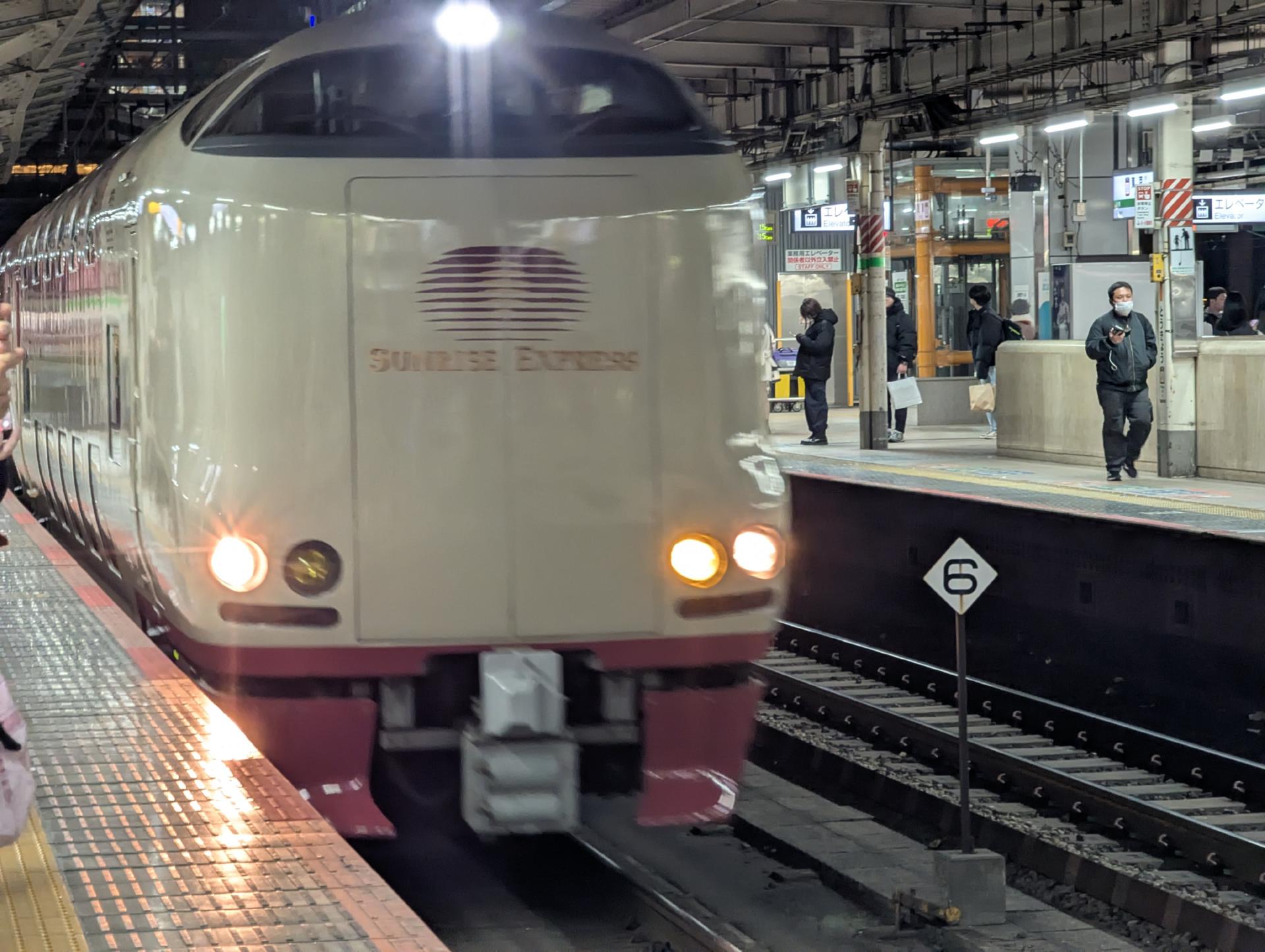
Pulling into Tokyo Station is Japan’s last nightly scheduled sleeper service. There are special luxury cruise trains, but those aren’t available to ordinary commuters. This is actually two trains, two services in one. The Sunrise Izumo runs between Tokyo and Izumoshi Station in Shimane Prefecture. The Sunrise Seto goes to Shikoku, another one of Japan’s four main islands. He two trains run as a single unit until Okayama, where they split and head off to their respective destinations.

I was planning to go to Takamatsu after Choshi, but they are quite a distance away and I couldn’t make the times work in a single day.
Then I saw the Sunrise sleeper running on the layout at the SC Maglev and Railway Museum in Nagoya. When the only other cars where track maintenance vehicles, the sight of the long Sunrise train winding its way through the night stirred something in me.
No harm looking. To my surprise there is a single seat left on the train. I book it.
There are many different accommodation options on the Sunrise Express, from luxurious individual cabins with their own showers, private single and double cabins and then there are the nobi-nobi compartments. Instead of seats, the nobi-nobi compartments are partly segregated carpeted areas, each with their own window and lights, but no power outlets.
The nobi-nobi compartments are the only ones that a JR Pass holder can reserve online. So that’s what I’ve got.
The doors open and I carry my gear on board. The nobi-nobi compartments are arranged on two levels, like bunks with the head at the window and the feet at the aisle. I am on the bottom level in 4B in car 5.

The wooden partitions between each nobi-nobi extend only around the head area, so there’s not much privacy. A white blanket and pillowcase, sans pillow, are placed in each compartment. I had hoped to buy a cheap yoga mat to sleep on, remembering the torture of sleep in the hanok villa on a wooden floor. Unfortunately, I couldn’t locate one so, like a number of others, I decided to use the blanket as padding and a Jetstar blanket on top of me.

You remove your shoes before climbing into the compartment and leave them below the shelf. There’s not a huge amount of room for luggage. I pushed my bags towards the windows and had enough room on the side and to stretch out. Those with big hard cases would be in trouble.
There is a blind at the small window at the head of the compartment and curtains at the foot of the compartment for a little privacy. I see space for curtains between compartments, but none are mounted.
I used stuffed clothing compartments and my jacket as a pillow, try to charge my empty phones with a power bank I bought for this purpose.
There are showers located in some cars, but you need to purchase a shower card to use them and they quickly run out. I can’t be bothered. There are no meal facilities on board, only vending machines with a limited range of drinks.
I didn’t realise this until I saw the indicator board on the platform, but this train is one of those special services that actually go beyond Takamatsu to Kotohira. When the conductor comes to check our tickets, I ask if I can continue on and he has no problem with it. My pass covers it and nobody is going to need the compartment. I don’t think they are reused if you get off early.
Final announcements are made and we begin to pull out of Tokyo Station at 9.50 PM. The compartment windows are a bit blurry, light flashes past out the big aisle windows.
It’s different to your normal Japanese train trip. There are a number of early stops, like Yokohama and Atami, before the lights are turned off and announcements stop.
I write my blog for a little, but I’m tired. In the past I’d be looking out the entire journey, but my body really needs sleep. I pull my curtains across, pull the blanket up and try to sleep.
I do sleep. Almost five hours, before waking at 4.20 am after dreams. I’m a bit stiff and numb, but it feels like a real sleep. I see us pulling into Osaka, one of the stops along the way. I think I’m so familiar with the area I just know the sounds of us crossing the bridges.

I close my eyes again, get a bit more sleep. The compartment alternates between too hot and pleasantly cool. I don’t realise the vents above my head are actually functional until too late, warm air comes out from vents between the compartments.
At 6 AM the lights come on that announcements are made that we are approaching Okayama, where the train will split. I try to keep resting as long as I can, but I do want to see us cross the Seto Ohashi Bridge. It is always a magnificent sight as you cross high above the waves, the tiny islands of the Seto Inland Sea are a classic scene from Japan, even more beautiful in the pre-dawn light.


We visited Takamatsu last trip and the scenery is familiar from that trip and others before it. We pull into Takamatsu for a while, enough time for a number of passengers to get out and buy souvenirs or leave the train entirely.
Eventually we reverse out to Tadotsu and our final stop of Kotohira. The train is mostly empty by the time we arrive at our final stop. I pack up and carry my gear out, spend the time admiring the train.
The ride was a lot better than I expected and the nobi-nobi seats make more sense than an upright seat overnight, and I’ve done plenty of those. A bedroll and pillow substitute would make a difference for comfort, but it’s definitely one way to cover long distances without taking up exploration time.


One thing to note is that most Japanese hotels are not great at allowing you to check in early or cope with arrivals after midnight. Nor are there train lounges. So you need to factor in that you might not have a chance to freshen up after your trip.
In the next instalment, I’ll reveal why I went all the way to Kotohira.