Hikari 703: Tokyo to Shin-Osaka
The young man with the privacy screen on his laptop is keen to tell me in English that Mount Fuji will be visible out of the window soon.
It is not. The drifting low clouds hide the volcano, as expected. The landscape is rich, a deep green in the near-tropical warmth and humidity that signals the approach of summer.

Grey and brown cities flash past, mirrored rice paddies, tea plantations on rounded hills, factories, offices, solar panel fields, mountain ranges and cluster of bamboo. Familiar, but different to the winter travels as the seasons change the landscape.
A chance to relax in comfort, an escape from the anxiety of flying, a lack of sleep. Joe Hisaishi provides the soundtrack.
Cities punctuate the journey. Yokohama, Shizuoka, Hamamatsu, Nagoya, Kyoto. The skies clear.

An early lunch, a bento of chicken and tomato rice purchased from a platform kiosk in Tokyo. It isn’t the self-heating box, a disappointment caused by not paying enough attention.
Kuroshio 9: Shin-Osaka to Gobo
There are photos of pandas on the exterior of the 287 series limited express train. But there are no pandas at the zoo because China and Japan are having one of their diplomatic disagreements.

This is another route I have done before. The first part is too familiar from travelling between Kansai International Airport and Osaka.
Tightly packed Osaka gradually changes to the semi-rural outskirts where shopping malls mix with canals, rice paddies and other crops. Beyond Hineno, where the lines to the airport and Wakayama split, the track moves into the mountains, then emerges into the coastal city of Wakayama.

A giant Santa Claus stands a top a narrow yellow building, one arm thrust out towards the sky, the other dragging a bag of gifts. The Hotel Chapel Christmas in Wakayama does not look like a gift for weddings.
Factories, refineries, magnificent glimpses of the ocean. No mikan mandarins on the trees this time. Other towns, Kainan, Yuasa, stations skipped until we reach Gobo.
Kishu Railway: Gobo to Nishi-Gobo and back
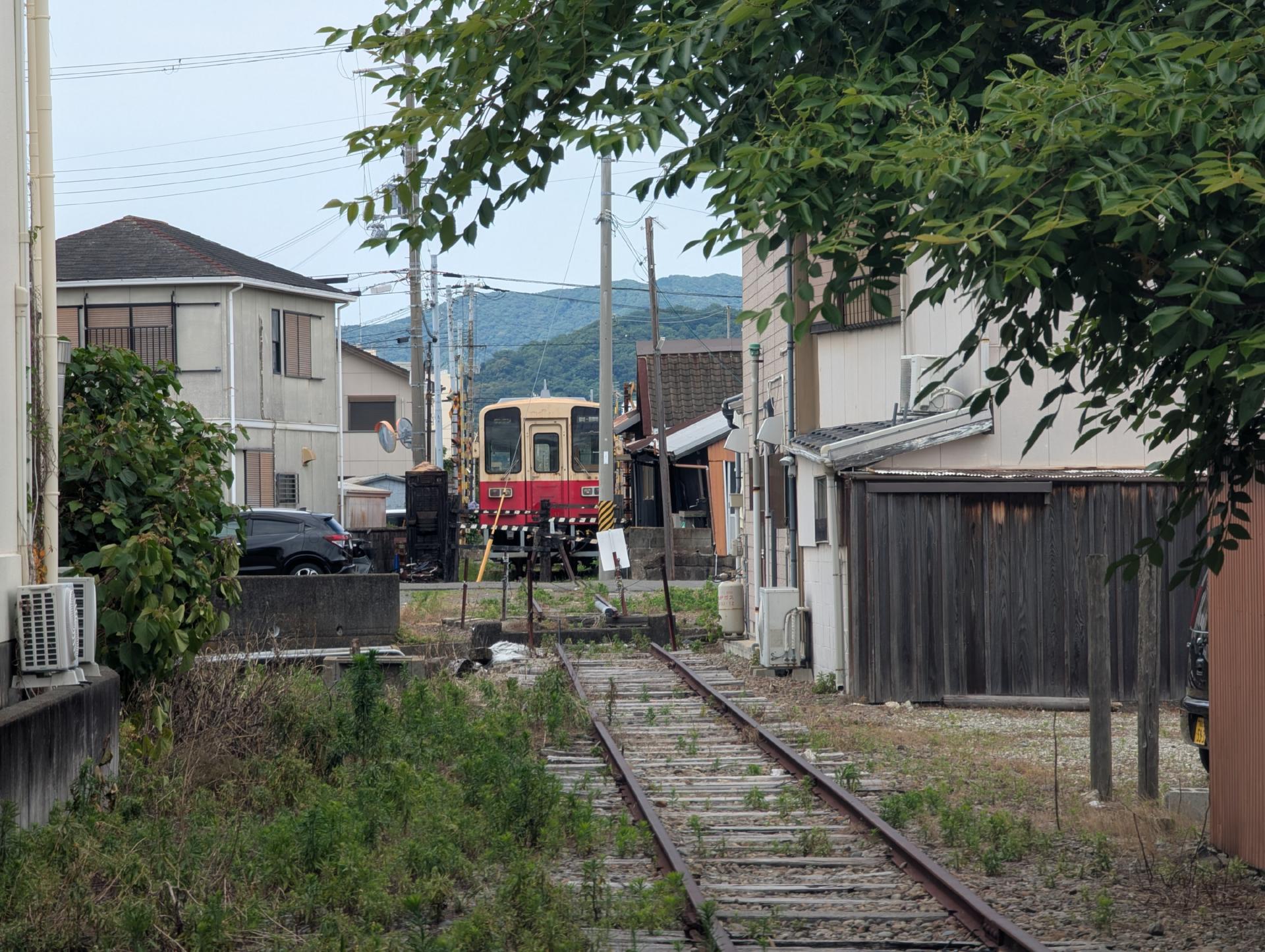
At 2.7 kilometres long, the Kishu Line is Japan’s second shortest with a regular passenger service. It once ran longer, but 0.7 kilometres were closed in 1989. That’s still a shorter distance than between our house and Alex’s high school, a distance he sometimes walks.
According to Wikipedia, the corporation that owns the Kishi Tetsudo, or Kitetsu, bought it for the prestige of operating a railway. Their new Chinese owner would prefer to focus on their hotel and property business.
Considering the short distance, the aging and declining population and the expense of maintaining the rails and the equipment, it is little wonder that the Kitetsu is in danger of being shut down. It is difficult to believe that a bus wouldn’t be more appropriate.

A red and cream diesel rail motor sidles up to platform 0 at Gobo Station. The paint is flaking from its sides, the windows are stained. Two other passengers board, an older woman, and another, younger, densha otaku from the subcontinent, phone in hand to photograph and video. Smiles are exchanged.

The driver shifts ends and the train trundles off, the track curving away from the JR I had just arrived on and past urban rice paddies. Despite the short distance there are five stations on the line. The old lady steps off at Kii-Gobo, where a disused green and white rail motor rusts away on one siding, while another, still in use, hides in a shed.

The other otaku leaves at the penultimate station of Shiyakusho-Mae, for whatever reason of his own. I travel to the end, Nishi-Gobo, the rail motor pulling up right at the buffer.
The wooden station looks like it is collapsing, that the platform veranda is too low to duck under.The walls are adorned with photos of the Kitetsu, there is a book to sign, though the pen has no ink. A waiting area, a vending machine.

The train will idle here almost an hour before it heads back. Beyond the stop are the remains of the old continuation of the line. With time to kill, I get off to explore.
The area is not as dead as I had expected. A big new Tsutaya bookshop and Super Value NEX supermarket are across the road, further down a 7-Eleven and a Lawson konbini. I head towards the latter for a drink. It is quite warm.
Other shops have not fared so well. A couple of closed cafes and shuttered workshops. Another building might have once been a small Pachinko parlour. Or something else. It can be hard to tell with the exuberance that some business owners once had.
I walk some back streets, looking for the tracks rusting away, tracks crossing a road, only to disappear into a jungle of vines and trees. Further up, a well maintained villa, then a return to the ramshackle station.

It is quite warm outside, the air conditioning inside the rail motor a surprise. One other passenger waits inside, a couple of others join us further along our return, which I video for posterity, standing at the front of the train. This incongruous little line does have a kind of magic about it as it trundles through the sleepy town. A bus can never share that.

More passengers are waiting at Gobo, videoing me videoing them as we pull into the platform. I doubt that I will ever ride this line again, no matter if it survives or not. There is simply no reason to come here.
Gobo
With a bit of time to waste before the return train to Shin-Osaka, I wander around the station area. I should have left my small roller case in a locker, the existence of which is not listed on Google Maps. I can report that the men’s bathroom facilities, one Washlet, one squat, are clean.

There is little open adjacent to the station. A couple of hotels, a cafe which I regret not visiting, a Lawson konbini and a tourist office selling local omiyage. I buy boxes of mikan snacks, including some mikan flavoured potato chips, and some drinks. I am grateful for the extra rom in the suitcase, left for this eventuality.
Waiting at the platform, I watch an old lady throw seeds or fertiliser from a basket into the fields.
Kuroshio 24: Gobo to Shin-Osaka
This train is not decorated with animal decals, but the seats are thickly padded and comfortable. It is time to sit back, relax and stare out of the window. The summer light has taken on a hazy quality, casting the world in golden hues which will continue to grow richer until the sun sets.

In the distance, the silhouettes of aircraft descending into Kansai International Airport, my usual gateway to Japan. In this sky of only faint, thin cloud, I do not feel anxiety about those flights, though no doubt it would be different if I was about to board one. Normally we would be passing in the opposite direction at this time of day, heading towards that airport instead of away.

Notice the remaining rice paddies embedded in the housing developments that have supplanted them. Further into Osaka, dense housing without gaps aside from the narrow streets. Vignettes of life, as crowds of people walk the streets past izakaya, cafes, fast food chains, hairdressers, cram schools, two kids fighting with toy swords in a park, supplanting the ugliness of concrete and brick with the colour of humanity.
Sakura 765: Shin-Osaka to Kokura
My meals in Japan have been obento, dinner is no different, with a beef and rice box from Shin-Osaka to stave off the hungry of a too-early combined breakfast-lunch.
The pale blue Sakura Shinkansen, bound for Kagoshima on the southern extremity of Kyushu, belies the rich browns of wood and cloth in its interior. The seats feel like first class instead of standard. The intention is to relax and write, but the golden light outside is too distracting, painting the city buildings, reflecting off the mirror-paddies.

As the sun sinks red behind the horizon it is as if the spirits awake and Japan takes on a new life. Neon signs point to where they gather. Pachinko parlours, karaoke, izakaya, family restaurants, sports halls.
The harsh lines of giant factories contrast with the mysterious islands of the Seto Inland Sea. The black castle in Okayama, the Mazda Zoom-Zoom Stadium of the Hiroshima Carp baseball team. Business hotels clustered around the high speed stations. Places for people in transit.

A long dark tunnel beneath the ocean heralds our departure from the main island of Honshu into the southern island of Kyushu and our arrival into Kokura. A 500 Series Shinkansen departs from another platform, grimy, worn, ready for retirement, but still with such beautiful futuristic lines.

Exhausted, I check into the Station Hotel, with its liminal space corridors, then return outside to find some food. Wander through the lively arcades of youth, drunks and touts, end up just drinking an almond flavoured shake from Zetteria and buying fruit jelly, then returning to talk to the family at home. Time to sleep.