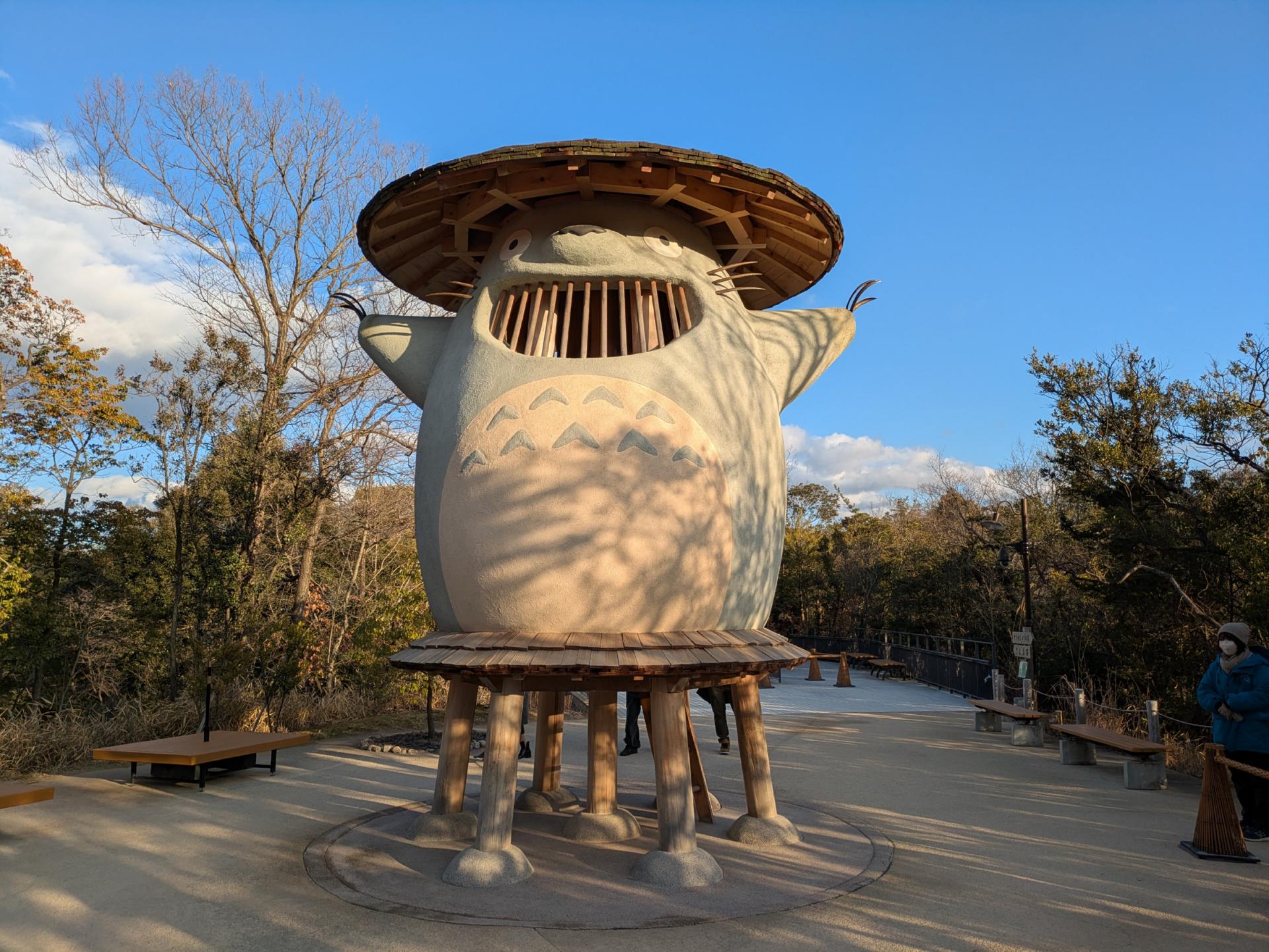
Studio Ghibli is beloved around the world for its animated movies, including My Neighbour Totoro, Spirited Away and Princess Mononoke. They have also become a theme of our past few trips, from the Ghibli Museum in Tokyo last time we were in Japan, and exhibition in Singapore and watching Spirited Away at ACMI in Melbourne. This time I set my alarm and booked tickets online to Ghibli Park in Nagoya for today.
Unfortunately, the day does not begin with a sense of joy. One of Alex’s friends, Lachlan, passed away from a rare form of brain cancer the day before our trip. The funeral service is streamed live at 6.45 am Japan time, which means that Alex has to wake up very early to watch.
With the service done, we have to hurry to the other side of Nagoya’s main station to catch the Higashiyama subway to Fujigaoka. The platform is as crowded as I have seen any Japanese train station, with lines to each door winding around, managed by attendants. There was a strains seem to arrive every minute, we catch the third one and squeeze on board.
Tickets to Ghibli Park are limited and have strict entry times. It’s about an hour’s ride on public transport from Nagoya Station.
Most passengers leave at Sakae, a couple of stations further along, and we get seats until the terminus at Fujigaoka. There we change lines to the Linimo, an elevated and automated magnetically levitated train service.

The Linimo isn’t like the only other maglev we’ve caught, the 431 km/h service in Shanghai to the airport. It’s a much slower commuter service that floats smoothly along at a maximum of 100 km/h guided by a couple of tracks.
We disembark at Ai-Chikyuhaku Kinen Koen Station and enter the site of the 2005 Aichi World Expo Park. From there we enter through the Elevator Tower, a steam punk style building that forms part of the Hill of Youth section of Ghibli Park.

It not many degrees warm today and I’m not wearing my snow gear anymore. Still, it’s nice to be free of the heavy boots and multiple layers.
The queue is already building at the entrance to Ghibli’s Grand Warehouse, which is in a big exhibition building opposite an indoor ice rink. We have the Premium Sanpo Tickets which give us entrance to the Grand Warehouse and the rest of the park, receiving wrist bands to show this.
Ghibli’s Grand Warehouse isn’t just a big shop, as the name might indicate. It has many sections that will excite lovers of Miyazaki and the studio’s work.
The centrepiece is a giant mosaic tile staircase in the style of Gaudi’s Park Guell in Barcelona. Over this floats an intricate giant floating ship driven by propellers and flapping legs.


We join the queue for the recreations of scenes from Ghibli movies, giving visitors the opportunity to be photographed in them. The first is probably my favourite scene of all Ghibli movies, sitting inside the train in Spirited Away. Many other scenes follow, vignettes that give you a sense of being inside the movie, not just photo opportunities. That is probably the greatest part across all the park, an opportunity to live the fantasy.


There are then other exhibitions of items from the movies, including a fascinating one showing the level of detail required in the production sketches to properly animate the act of eating.

We emerge just in time for a screening of an original Ghibli short film in the cinema. The movie showing this month is The Day I Bought a Star. The dialogue is entirely in Japanese and the plot isn’t entirely clear, (“Time Bureau” isn’t a phrase you normally learn in Japanese), but it is absolutely beautiful.
The film is based on the story Iblard by Naohisa Inoue. The protagonist Nona lives in a city where the Time Bureau works to prevent the wasting of time. He runs away and meets Ninya, obtains the glowing seed of a planet and moons from two strange animal characters and watches it grow.
I buy a booklet about it from the Warehouse shop so I can appreciate it further.
Another section of the Warehouse recreates scenes from Arriety, which is B’s favourite Ghibli movie. It is about tiny people called “Borrowers” who make a life inside a full sized house. Rooms and gardens are scaled so that visitors are borrowers themselves.

After trying cakes and fruit milk from the Siberia stand (not outstanding), we wander through the crush of the shop, then exit the Warehouse.

It’s now a walk to the Valley of the Witches, entering through the mouth of a giant mosaic witch. Our first port of call is the Flying Oven, a restaurant with another long queue. There are roof mounted heaters and each time the queue moves and positions us beneath one is a relief. It is quite chilly outside!

We have a lunch of roast pork, pork pie and a black witches Japanese vegetarian curry with eyeball pannacotta for dessert. Comfort food for a cold day.


Witches and magic feature in quite a few Ghibli movies. Bella Yaga’s workshop is a lot of fun with strange brews and all sorts of horrible ingredients. Then we climb up Howl’s Moving Castle, an insane steam punk contraption, this time with a magician’s messy bedroom of exotically magical objects.


There are sets from Kiki’s Delivery Service and French pastries to be had from the Guchokipanya Bakery. We didn’t try any of the rides as Alex is a bit too old for things he used to love.

Note that many exhibits don’t allow photographs indoors, so it’s up to you to see it yourself.
With our time limited, we decide to skip Mononoke Village and catch a free bus to Dondoko Forest, home of the Satsuki and Mei’s house from My Neighbour Totoro, one of the earliest and most charming Ghibli movies. No dust bunnies to be found, but it’s shoes off inside.


We ride the Dondoko-go slope car, a tiny monorail, down and make our way back to the bus stop. It’s almost 4 pm and most things are starting to close. The bus returns us to the park entrance and the Linimo Station.


Being automated, you can see out of the front and rear of the Linimo trains. The horizon is turning orange and grey as we begin our journey back, taking us past the Toyota Museum that we didn’t visit a few years ago, despite having bookings.


At Nagakute Kosenjo we leave the Linimo and walk to the nearby AEON Style mall. Aeon is a more downmarket department store and supermarket chain where you can get reasonably priced goods.
B is specifically hunting for the 80°C flavoured agar jelly powder brand. We can’t find it, but there’s other interesting food here.
On the way in we stop by a Nitori, a well priced household goods and furniture chain, but only purchase a vegetable peeler. We’ve previously bought down doonas and pillows from them.
Alex says he feels queasy and not hungry, but that seems to change once we go to Shabu-ya, an all-you-can-eat shabu-shabu hot pot restaurant. Broiling thinly sliced pork and bountiful quantities of vegetables in flavoured broth is expensive, but one way to get your fresh vegetable count up in Japan.

He’s even well enough to get some Beard Papa cream puffs for dessert later.
There has been a miscounting of clothes required during our stay by the other two, but fortunately, Muji sells reasonably priced t-shirts and underwear and lots of enticing snacks.
I like these local shopping malls where you are often the only tourist. It almost feels like you are living a normal life in Japan.

As usual, it’s getting to closing time and we need to return our exhausted legs to the hotel. We now continue on the Linimo and Higashiyama Line to Nagoya Station. Fortunately it’s not as crowded as in the morning.
There was some question whether Ghibli Park would be worth it after the Ghibli Museum. I think we all agreed that it was. Miyazaki’s worlds are magical places of fantasy and it’s a delight to escape the real world’s troubles for a while. I’m glad we went.