After last night I really want to sleep in. But it’s not possible. We have a Shinkansen to catch. It shouldn’t be hard, because 8 am is 10 am back home in Sydney. But then last night’s midnight was 2 am.
There’s a display showing 1°C outside our window. A 500 Series Shinkansen races past. Not the one we’ll be catching.

So we check out and walk to Shin-Osaka Station. The air is crisp and clear, the sky blue. It looks like a really nice day, if cold. We buy sandwiches and onigiri for breakfast and board our 700 Series Hikari Shinkansen for Osaka.
We are in the rear seats, where there is space for luggage. You need to reserve it. A couple of fashionable young Italian ladies didn’t and were forced to move their oversized suitcases.

Around Otsu we see snow clouds touching the mountain ranges in the distance, then as we turn inland towards Maibara the landscape turns white.

Snow!
Covering roofs and cars and solar panels. Some areas have a fairytale dusting of white on the forests and gardens, others have turned monochrome.

The snow and the winds are also causing issues with the rail network with warnings of delays. Our connection in Nagoya is tight and we have a bus tour to meet later.
Fortunately, the delay is only about 5 minutes and we make our Takayama connection. It is our first trip on the new HC85 series hybrid DMUs, replacing the 85 series that used to run the Wide View Hida Express since our first visit. I’ve got a model of that one. The HC85 uses regenerative braking to charge batteries, displaying when they are functional on the information screens at the ends of the carriages.

The new units are nice, especially inside, and have sorely needed luggage space considering the tourists which flock to the area. The service features commentary on sights visible outside, including Inoyama Castle which we visited a couple of years ago.

The train runs in reverse up to Gifu, then changes directions for the Takayama Main Line. The route follows the Kiso River, then the Hida which feeds it. It was the Takayama Main Line that, more than anything, made me fall in love with Japanese railways. It is incredibly scenic and the winter snow scene is possibly the best time to view it.
Tiny towns and roadside stops cling to the edges of the narrow valley. The river is blocked by several dams and hydroelectric power facilities, forming lakes and elsewhere dancing between boulders and narrow rocky rapids.


The longest tunnel separates the rivers flowing east and west. When we emerge we now follow the Miyagawa into Takayama.
Our first task after leaving the train is to collect our bus tickets. Initially we wanted to stay in Shirakawa-go, the famous World Heritage listed village famous for its gassho-zukuri A-frame house architecture. Every winter it hosts a few nights where the town is lit up. That makes it difficult to find accommodation. Fortunately, I found some last minute bus tour tickets for the event.
Next we need to find our Takayama hotel. This means trudging through the snowy streets, which is why we are wearing our snow boots. B has bought some extra annoying metal cleats for hers that need to be strapped on and removed when indoors.
When we arrive, we discover that the Machiya has upgraded our room. It’s magnificent! A couple of futons on the floor, a hinoki cypress bath, a view of a tiny garden covered with snow.

Then it’s past time for lunch. In April it will be twenty years since our first visit to Takayama. We were there for the famous festival parade, but we also fell in love with the old town, the crafts and, most of all, the food.
B wants to go to Suzuya, but they’ve finished for the day. Instead we return to our favourite Hidagyu Maruaki, where we splurge on a plate of A5 grade Hida beef to grill at our table.
It’s so succulent and juicy, just melting into your mouth. The vegetables and side dishes are tasty grilled too. I’ve never eaten any other beef that compares with a good piece of Hida beef. We are spoilt.

After checking out some omiyage it’s about time to catch the bus. There are 8 coaches heading to Shirakawa-go, all parked in a row. The drive takes about an hour, running through more spectacular mountain scenery and long tunnels. I fall asleep for part of it. I am absolutely exhausted with a headache constantly hovering in the background.

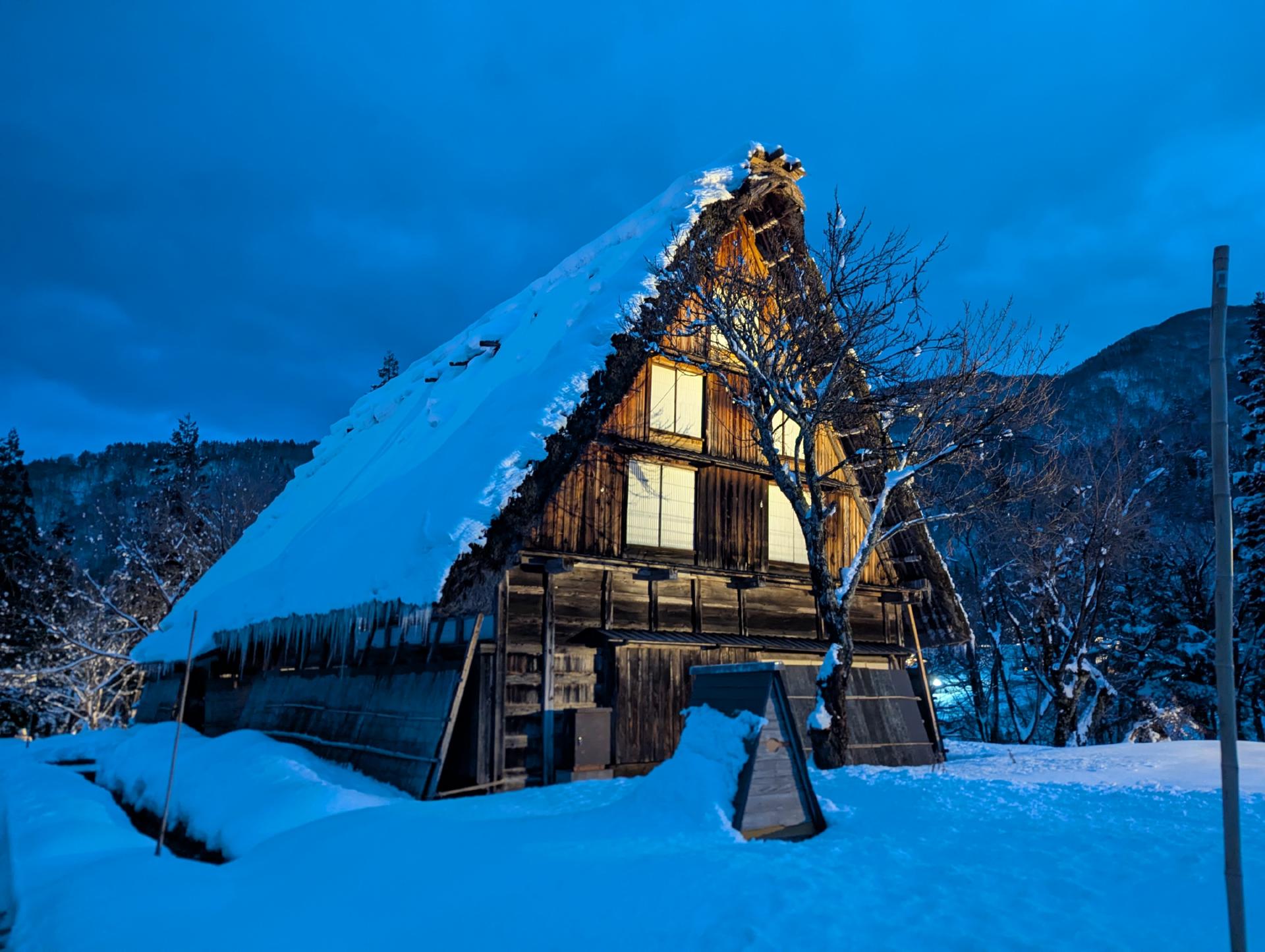
It is dusk when we pull into a carpark absolutely packed with coaches. Our unguided tour package includes entry into the Gassho-zukuri Minka-en, an open air museum of preserved farmhouses.

Gassho is the steepled shape of praying hands, and refers to the shape of the thatched farmhouse roofs. These wooden structures have at least two levels. An irori, or fireplace, warms and cooks and the smoke helps preserve the straw.
Not all the buildings are open or accessible, but it’s pretty to walk around. Our ticket also includes a bowl of red bean soup at the Nakano Chojiro rest house in the park. It’s a pain taking our snow shoes off, but the interior is warmed by irori, open fireplaces.

Normally I’m not a fan of red bean desserts, but this one is so nice and the rice cake in the middle is delicious. Perfect warming food this cold snowy day.
We then cross the rope bridge into the town and join the throngs of other tourists photographing the illuminated buildings. It’s a magical environment, with light flurries of snow drifting down and beautiful reflections in the rice fields. The lack of street lights means the light spilling out of every open shop or building becomes a tiny illuminated vignette against the darkness and the white snow.


I should like to come again, in a quieter time, and stay the night in an old farm house. But for now this is enough.
We return in darkness to the bus and retrace our journey to Takayama. Many eateries are already closed and we don’t feel like the rich foods of an izakaya. So it’s another konbini dinner, brought back to our hotel room to be eating in front of the miniature garden view.
I recognise again many of the comedians on Japanese television from Netflix.
This is my first soak in a wooden bath. It is such a pleasant feeling compared to hard tiles or enamel. I feel more refreshed and energised now, the anxiety of the past week finally flowing out to sea like the meltwater in the rivers we passed today.
