Another castle? Aren’t you sick of castles?
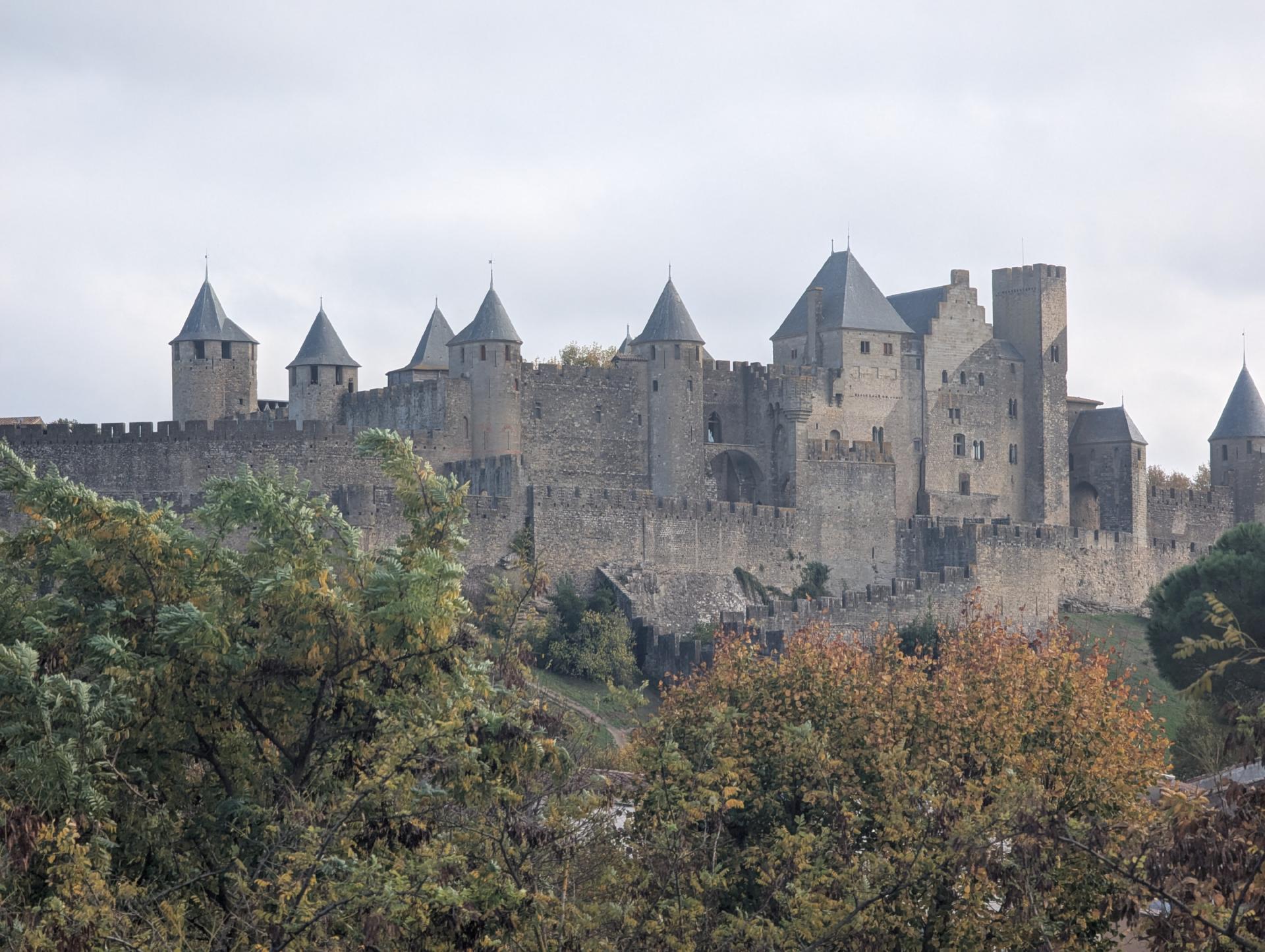
Carcassonne, less than an hour by train from Toulouse, is one of the most popular sights in France outside of Paris. The city is famous for its Cité, the UNESCO heritage listed castle that overlooks it.
Prior to this trip I happened to watch a documentary about the castle on SBS (I also saw one on Neuschwanstein, but we couldn’t make it to that one).
We catch a regional train to Carcassonne. It’s a fast, comfortable and smooth ride through very nice scenery. French villages, vineyards, grain silos. Dogs playing on farms, old factories, ploughed fields. Cars parked under the arches of farm sheds that once house farm equipment or horses.


Opposite Carcassonne’s station there is a large Ferris wheel under construction along with other fair rides. There’s a bit of a walk from the station to the castle, over 2 kilometres. It’s a fairly pretty town. In one square Christmas festival preparations are being made, though why there are cable car cabins sitting there is a mystery.

We pass one shop with koalas, a “Kangaroos next 3 km” and an Australian flag in its front window.

Ah, she is a real estate agent with an Australian name, come to wreak havoc on France. Lovely.
Carcassonne’s Cité is on a hill overlooking the city. First we cross the Aude river and then climb up the paths and stairs to the entrance.

A bit of history may be helpful here, though I will skip a lot of details here. Around 2,500 years ago Carcassonne was a Roman fortified town. Following their collapse the Muslims, Visigoths and Franks took over. But the Languedoc (Occitania) region was rather independent, speaking their own language and practicing traditions different from their more northerly French peoples.
Around the 12th century the Catholic Popes and many of their bishops were perceived as greedy and corrupt. Catharism was one response, a belief that there were two creators, the “good” God of the New Testament and the “bad” God of the old (Satan) and that souls were not intrinsic to a body but received from angels. Only perfect souls could regain Heaven, others were stuck in a cycle of reincarnation until they got there.
With an independent mindset and dissatisfied by the quality of church representatives, many in Occitania embraced Catharism to various degrees. Even if the local rulers did not openly share their beliefs, they protected believers and also sought to establish their own control.
The Trencavel viscounts fortified towns, including Carcassonne, building up its defences and making it a stronghold.
The Cathar faith was seen as heresy (and a threat to power) by the Catholic church. In 1209 Pope Innocent III launched the Albigensian Crusade to purge Occitania of Cathars and succeeded in conquering Carcassonne. The French King Phillip took over the city, using it to defend the southern flank of France against the Spanish until the frontier expanded.
The latter event signalled the decline of Carcassonne, with stones from the wall being repurposed for local housing. But in 1840 local historian Jean-Pierre Cros-Mayrevieille had the castle listed as a national monument and Eugène Viollet-le-Duc was entrusted with its restoration.
This is the castle we are visiting today. There is an outer wall, the most recent addition by the French forces, the original inner wall that protected the residents and the actual castle, the home of the Trencavel rulers inside. An outer mote surrounds the wall, but it was always a dry moat.


We buy tickets to the castle museum and battlements, then make our way up the narrow road lined with souvenir and tourist item shops, stopping to purchase biscuits and nougat.


There is some complaining once we enter the ticketed castle, because no breakfast has been eaten. However, the offer of a hot chocolate from the stall is rejected. Might as well start exploring.
As mentioned, this central castle was the home of the rulers. In addition to the residence, which contains various displays about the castle, there are high walls that can be walked around.


Next is the battlements walk, where you take a circuit around the inner wall surrounding the “city”, passing through the many named towers along the way. It’s a long walk and many steep steps and narrow spiral staircases, but the views are incredible, both outside and within the town. The distant Pyrenees, the vineyards, churches and residences, gardens with statues, a forum for performances.
Even without the history, it is a magnificent sight, butl there are interpretive signs placed regularly along the route, giving the history of the towers and battlements. The round bastions that provided coverage of invaders and funnelled the into narrow defiles (I learned that from the documentary). The inquisition that tortured Cathars who refused to repent, the lack of a water supply that first saw the city fall and how rainwater collection and extra wells were designed to solve that.
Some of the original Roman towers remain, identifiable by the rounded fronts and other sides straight. Then there are grand additions by the French. Multistory towers with their own salt rooms and bakeries. A tower for keeping tax records and archives secure.


My knees are glad for the end of the battlements walk and the return to the castle. It is definitely time for a good lunch and this time we are actually early enough for it and we know what dish we want to order: The famous cassoulet.
There are undoubtedly better restaurants than in this prime tourist location, but we will not have a chance to visit them.
At Auberge de Dame Carcas we order an entree, main and dessert set. The entrees are:
- Duck confit quiche (me)
- Burrata with pesto (Alex)
- Roasted goat cheese on toast with salad (B)
As predicted, the others don’t really like their dishes and I end up swapping with them.


We all order the cassoulet, a thick haricot bean stew with Toulouse sausages and confit duck. I love the rich flavours, scrape up every last drop. The others leave half their beans.
For dessert, Alex orders the “Dame Carcas” sundae (cherry sorbet and vanilla ice cream, red fruit coulis and whipped cream). B initially orders a cheese platter, but after the goats cheese of the entree, changes to my order, the house creme brulee, which is silky smooth and delicious.
Now very full, we return down the hill to Carcassonne and the station. The Ferris wheel is almost complete.


A local service returns us back towards Toulouse, but our stop is one before at Montaudran. From there, it is a very short walk to Halle de la Machine. We arrive just in time to ride the Minotaur, a fantastical 14 metre tall wood and mechanical beast.


With a hiss and a roar, spray emerging from the Minotaur’s nostrils, chest puffing in and out, we slowly make our way out from the hall.

The hall sits on the site of the former Toulouse-Montaudran Airport, closed since 2003. The runway is now a broad boulevarde, the surrounding area modernised with shops, houses and a gorgeous garden.

Cyclists dodge us as we trundle and “walk” (the four legs move) in a circuit along the runway. The aviation heritage of the region is further highlighted by an Airbus Beluga, like we saw yesterday, in the distance on descent into the airport serving their factory.

The Minotaur makes an entrance into the hall, performs for the onlookers, then continues for a bit further before we come to a stop and disembark through the rear stairs. It is quite an experience and one probably worth seeing from the perspective of both a rider and a spectator.


Unfortunately, it is almost closing time. There are a variety of other mechanical items on display, like a steam punk or Studio Ghibli creation. Giant wood and metal spiders, a floating garden, musical instruments fused into contraptions of strings, pulleys and actuators.


It is time to head back, so we return to the station in time for a late running service to Toulouse.
After today’s lunch, neither of the others feel like eating a French dinner. Instead they go to Five Guys, an American hamburger joint with a branch in Sydney. I take a bite of their hamburger and feel sick.
My tooth hurts, much more since the heat of the cassoulet. I haven’t been using sensitive toothpaste and perhaps it’s that, or maybe I do need the root canal work the dentist warned was a possibility when filing it recently. I go to a pharmacist to buy the toothpaste and just get some soft pastries for dinner.
It is not the nicest way to end such an amazing day, but it is Friday the 13th.