The road to Hell is long and winding. Or perhaps I shouldn’t have listened to the GPS when it suggested an alternative route. I can tell I am getting close by the smell of sulphur in the air.
The Aomori Railway is a third sector service between Aomori and Hachinohe using the main line tracks that existed prior to the Shinkansen, still used today for transporting freight to Hokkaido.
Their silver and blue electric multiple units fly between the cities and stops between, mostly through a mostly forested corridor. The Pacific Ocean appears around Asamushi-Onsen, a resort town dominated by onsen hotels that look, from the outside, like they may have seen better days.

I ride as far as Noheji, the junction with the isolated JR Ominato Line to the Shimokita Peninsula. Some Ominato Line trains also use the Aomori Railway line, running all the way to and from Hachinohe.
A single car JR East KiHa 100 railmotor pulls into the platform. I stand at the very front of the train, a good decision.
It is an absolutely gorgeous day with clear blue skies. The journey begins with a run through a corridor of trees. Then majestic wind turbines appear, kinetic sculptures spinning in the wind.

The line swings out along the coast of serene Mutsu Bay, the detritus of fisherfolk visible along the beaches. In the distance, the mountains of the peninsula.

This is an express service and the combined journey takes only an hour and a half to reach Shimokita, the penultimate station on the line. Here I pick up a Toyota rental car, only the second I have driven in Japan. There are a number of sights to visit on the peninsula and the buses can be slow and infrequent, especially on a Sunday.
This is a hybrid electric Corolla, a bit more advanced perhaps than the Camry hybrid I did my driving test in. I setup Bluetooth music from my phone, but the GPS proves to be a pain to set a destination in and there’s no Android support. I end up using Google Maps with voice navigation on my phone for some of the trip. I also have to figure out the gear and handbrake (sorry, footbreak) settings.
Set, or close enough, I somehow succeed in setting the destination as Osorezan and set off. What speed is correct? There’s the speed limit and then there’s the speed the locals drive at and tailgate if you don’t speed up.
The GPS warns of a seasonally restricted route, would I like to go via another? Okay.
Not certain that was a good idea or not. I find myself on a very steep and winding road into the forested mountains with many tight hairpin bends. I am so glad that there is little traffic and nobody following me, because I am going at a cautious pace that I feel safe and comfortable with.
Finally, the top of the mountain and time to descend into Hell, then stench of hydrogen sulphide in the air. A fork in the road offers the option of Mutsu, the original route, or Osorezan, where I am headed.
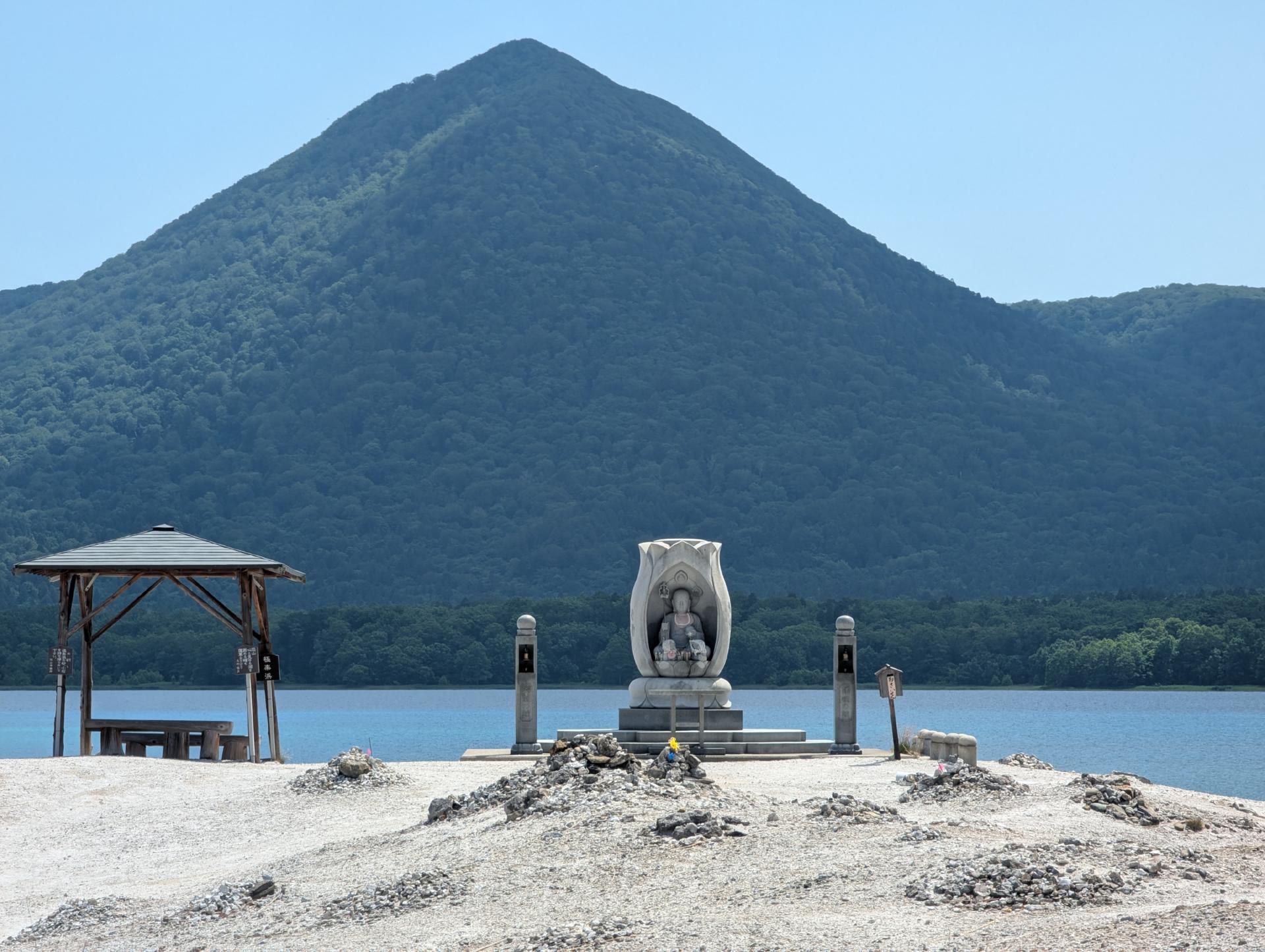
One of the three most sacred Buddhist sites in Japan, Osorezan consists of eight peaks surrounding Lake Usori like the petals of a lotus. I pull over at Sanzu no Kawa, the red bridge that souls must cross to reach the afterlife over the Osorezan version of the Styx, a clear river made blue with sulphur.

Further up is the Buddhist temple complex of Bodaiji and an otherworldly scene of bare blasted rock. Placed throughout the hellish landscape are monuments and statues, some grand, some tiny Jizo figurines, surrounded by bright plastic pinwheels and offerings of food and drink, often alcoholic, as devotees seek compassion for the departed.


This is the Sai no Kawara, the dry riverbed of Hell. Believers build piles of stones to help lost souls cross, demons knock them over. Vents in the rocks leach sulphurous steam, turning the gifted coins black and the landscape bright yellow. Rivulets of water flow down from the soils, carrying the sulphur across the landscape.


In one stream I spot a mass of tiny nightmarishly red worms writhing in the toxic waters.
The streams flow down to Lake Usori, itself toxic from the chemicals leaching from the volcanic landscape, the water clear, yellow streaks of sulphur visible on the lake bed.

There are onsen baths available in the temple for those who wish to experience the water for themselves. I believe they are very hot.
I must return to the world of the living. Giving up on the car GPS, I use my phone to plot a route out of Hell. Unfortunately, it is the same one that got me into there.
The road along with Pacific coastline of the Shimokita Peninsula continues to be winding. Fishing villages and small towns dot the coast, which has wonderful views of the ocean. Unfortunately, there are not many places to stop and take them in, but I pull over when I can, small the faintly sulphurous scent of seaweed, as if Osorezan still lingers.

Eventually, I reach Cape Oma, the northernmost tip of Honshu. The mountains of Hokkaido are visible across the water. A large statue celebrates the tuna fishing industry. It is past two thirty in the afternoon and I have had nothing to eat since breakfast. Unfortunately, the restaurants all appear to be closed for the day and only a souvenir shop remains open.

I buy crackers to bring home, unsure whether the dried fish and seaweed would pass customs and quarantine.
Further along now towards the famous Hotokegaura coastal rock formations. This is difficult driving, more steep and winding narrow roads. Fortunately, the traffic is very light. You never know if the kei car you are following is someone who always sticks below the limit or the one following you is a man person in a tiny box.
A stop outside Sai offers a view of a rocky headland. A couple of bare wooden torii mark a path to a shrine up the hill.

More driving, until the lookout over the famous sharp grey coastal rock formations of Hokotegaura far down below. The view is incredible.

There is a problem. Distances in this part of Japan are different to those in Australia. Winding roads, lower speed limits, have made progress slower than I am used to. Now the GPS tells me that I don’t have enough time to return the car before the rental shop closes, despite having an hour and a quarter to do 60 kilometres.
No time to look at Hokotegaura up close or to stop for any other sights. I now have to drive with purpose.
More steep winding roads that require patience first. Monkeys sit on fence posts and stare as I pass. I slow to let a mother and child cross. When the road crosses the range and becomes straighter I hit the accelerator. Still not as fast as in Sydney.
Past the Kawauchi Dam and lake, it is only as I approach Mutsu that I get stuck behind other cars. Traffic lights, city streets! The clock ticks over 6pm. I pull into the rental car yard less than ten minutes late and am greeted by the staff. I apologise. I haven’t even had time to refill the tank, but they say it is okay. I have barely used any fuel thanks to the hybrid engine. I am impressed.
I still haven’t eaten, but the train is expected soon.
It is delayed by a fallen tree. But by how long? Not enough to risk a meal, there are few trains and this one will get me back to Aomori late enough as is.
A train arrives from the Noheji direction. Fantastic! This is a one track line, meaning that this is likely to be the very same train that returns to Noheji, giving me the opportunity to ride it first to the fin stop of Ominato, for completeness.

The backdrop as we approach Ominato is Mount Kamabuse, Shimokita’s tallest at 880 metres and topped by a huge white military radar. The train crew quickly reconfigure the KiHa 100 for its return to Shimokita to pick up the other passengers waiting there.

On the ride back we are treated to the magnificent pastel pinks and greys of the evening sky reflected in the serene waters of Mutsu Bay. If Osorezan was Hell, then this is Heaven.

There is about a half hour wait at Noheji for the train to Aomori. The tiny soba shop on the platform is closed and little else is available in the station surrounds, except an ice cream from a vending machine.

The ride back to Aomori is mostly in darkness. The train arrives at 9pm and all but a few family restaurants and izakaya are open in Aomori. It has been over 12 hours since I last ate. Unwilling to deal with an expensive izakaya in this state of exhaustion, I just have a very late dinner at Ootoya. It is last orders.

Then free ramen, a hot soak, and a free ice cream to end a very long day to Hell and back.