Everyone hates rail replacement buses, but what if the bus was actually a train? This is the question I seek to answer today.

It’s Shikoku specialities for breakfast buffet today and who doesn’t want raw fish with garlic to start off their morning? More on this later.

My first train of the day is actually at a reasonable time of 9.30 AM. I’m catching a rail motor down the Mugi Line from Tokushima to Awa-Kainan. It’s quite busy with commuters initially. A rail worker sits at the very front of the train on a fold up stool, which is a pity, because I’d like to be taking photos there.

It’s mainly bland housing and dry rice paddies on the left. To the right in the distance are the mountains of Shikoku. I think I see snow atop some of them, but there is no sign of it at sea level.
Many of the passengers are headed for the city of Annan. After this we start rising into the wooded mountains, heading through tunnels of trees and rock. From Mugi there are glimpses of the blue coastline and dramatic rocky outcrops and islands.


A couple of stops later and we are at Awa-Kainan, the end of the line. It wasn’t always so. The tracks extended further, down to Kannoura, although it was operated by the Asa Seaside Railway Corporation, with the plan to extend it all the way down to Murota. Originally the further plan was to loop around the Murota peninsula all the way to Kochi.

That’s my plan today too, but it won’t be entirely by rail, because those rails don’t exist.
Now there is a break in the line at Awa-Kainan. But it’s not quite the end of the railway.
This is a sparsely populated area and the Asa Seaside Railway Corporation’s services were running at a loss. So they came up with an innovative idea: The DMV, or Dual Mode Vehicle.
The DMV is a small bus that has been converted to also be able to run on a train line. The same tracks that run south of the JR Mugi Line now have a break in them and curve off the path. A road leads up to them with a special entrance that guides the DMV on to the tracks.

Unfortunately, the DMV times don’t seem to match up with the JR train times and I’ve got a 40 minute wait in Awa-Kainan.
There is a flash wooden waiting room connected to the station which has bathroom facilities, brochures, lockers and a looped video about the DMV. Across the road there is a konbini, a stationery store and a patisserie, which I visit. You can get DMV shaped biscuits, along with other cakes and pastries.


I just miss watching an arriving DMV from the opposite direction do the conversion. Damn!
Eventually, the same DMV arrives to pick me up. It’s the green Sudachi (lime citrus) Breeze. The other two DMVs are blue and red in colour. I’ve reserved a seat online, as recommended, and the driver knows my name. It is possible that all seats are taken and there’s no standing in the bus.

My first impression is that this is very much a small Japanese bus. It’s lacks the width and the comfort of a proper rail motor. It is fortunate that it’s pretty empty today because otherwise there wouldn’t be room for my luggage.
As we enter the conversion point a video plays and a voice says “Starto!”. The video shows what is happening, with the rail wheels folding down and the bus being lifted in height. Once this is complete there driver exits to inspect, then we set off.
The speed is quite low along the tracks, which are elevated along viaducts. At the second station of Kaifu an old rail motor sits on a disused siding, showing what we are missing out on. The same at the rail terminus at Kannoura. But in between is wonderful. A series of short tunnels, like arches rather than dark passages, with the gaps giving fantastic views along the coast. This could definitely be a scenic tourist railway. It’s just a pity that it’s so isolated.


At Kannoura the transformation reverses and the DMV changes back into a bus. Then we drive down the spiral road from the viaduct.

I tell the driver I actually need to get off from the next stop to the one I reserved, and take a ticket from the machine next to the door. We then drive off to Uni-no-eki Toyo Cho, or Sea Station Toyo Town. There I leave the bus, which heads off to its terminus at Michi-no-eki Shishikul Onsen.

Now I’m stuck here for almost two hours. It’s a lovely spot, a beach in a small bay with rocky forested headlands. There is a very worn looking hotel, a big set of wooden change rooms for the summer months and a seaside seafood, fresh produce and souvenir shop and restaurant.


I’m not in the market for fresh vegetables or the ponkan mandarins that are sold. Nor can I do anything with the raw fish (I’m not having sashimi for lunch). I do buy fish for lunch, but it’s butterflied and grilled, served with seaweed miso soup, rice and pickles. I take my time eating it.

To wash away the fishy taste, I have a ponkan soft serve ice cream and that is very nice.
Now all I can do is wait around in the cold wind with my luggage, watching and listening to the birds of prey wheeling around, the jets en route to Kansai International Airport above them. I’m regretting the wheely case now.

I’m joined by a couple of other travellers for the bus. I’m relying on Google Maps to tell me where to go, but there are maps at the bus stop that also show the services.

The bus ride takes us all the way along the coast to the Muroto and the Geo Park Centre. It is an amazingly scenic ride, past fishing villages, beaches, around headlands, past big rock formations. If we were in a car, something I’m tempted to do in future, we’d be stopping frequently to admire the views.


When we pull into the Geo Park Centre Google says to continue to the Muroto Clinic, but the bus driver says I should connect to the other service here, and I trust his word more than Google. He gives me a discount ticket for the transfer.
The other bus arrives shortly afterwards and the three of us reboard. We were the only passengers on the other bus.
You can tell that it’s not an easy life out here. There are tombstones behind the sea walls, signs warning of tsunami inundation and pointing to paths and stairs leading into the hills. Many of the buildings look to be in poor states, one apartment block has simply collapsed from disrepair and abandonment.


But not everywhere is like that, and the school kids joining the bus at Muroto gives hope.

The views continue, except where we duck into the town streets. More passengers board this service. High schoolers going home, locals doing shopping. We round Cape Muroto and are rewarded with vast views of southwestern Shikoku, the low sun shimmering off the water.
Finally we arrive at Nahari Station, another third-sector railway run by the Tosa Kuroshio Railway. This was originally supposed to have connected with the Awa Seaside Railway, but those plans never eventuated.
I wish I had time to explore the station, but I need to get tickets and I’m about to burst. This is another elevated line and I catch a lift to the third level, where a single track terminates and a single diesel rail car waits.


Lucky they have a bathroom on board.
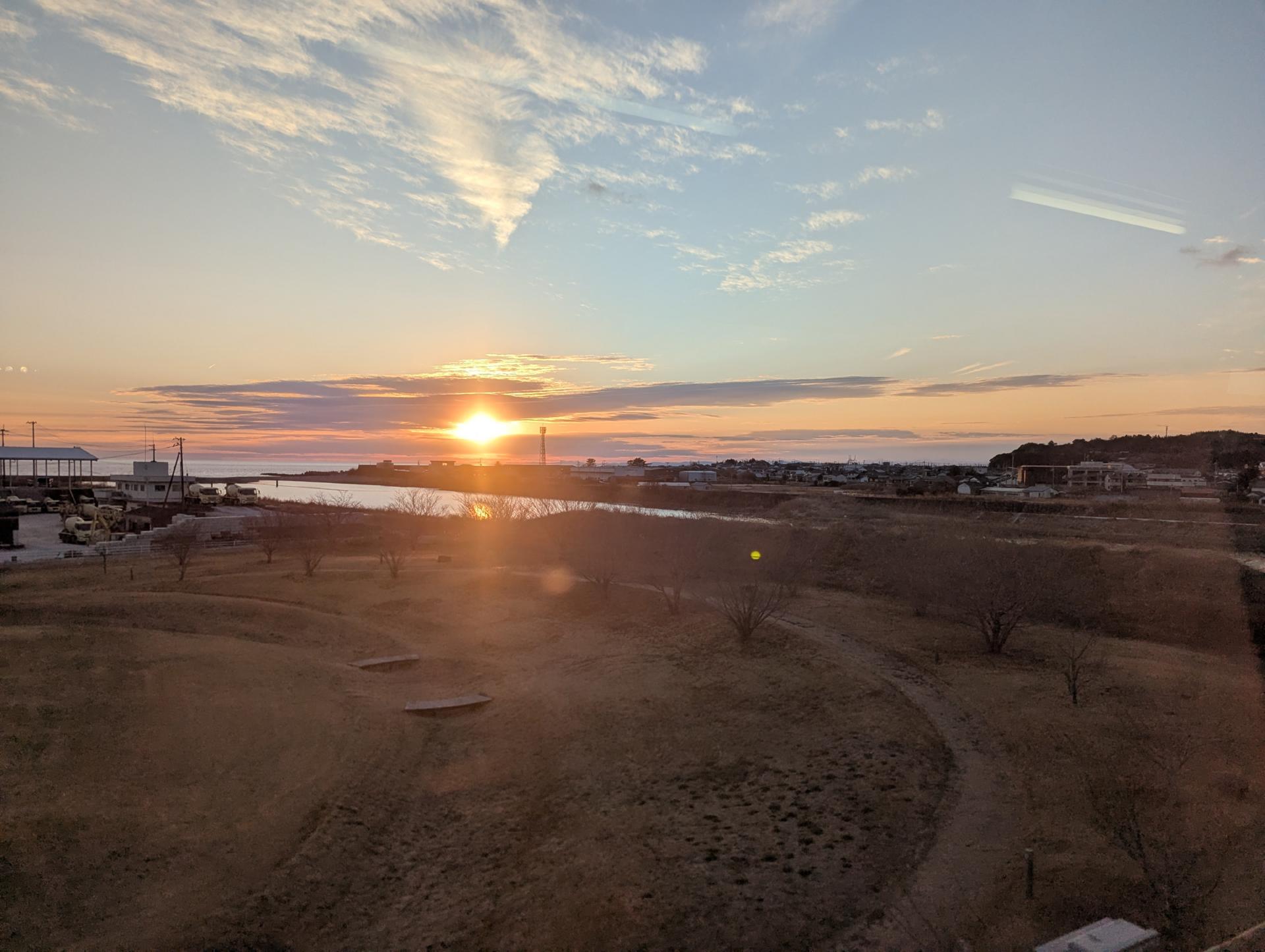
The sun is almost setting and the view is spectacular. The train fills up and we set off across a bridge towards Aki. I watch the sun touch the water of the ocean, disappear behind distant mountains, turn the ocean silver purple, the sky hazy gold and orange. Stunning.


I have to change trains at Aki, crossing the platform to the rapid express all the way to Kochi.
We swing inwards, lose the sea and I fall into microsleeps. I am still very tired.

I’m so glad when we finally arrive at Kochi Station. Across on another platform is a red Anpanman train. Shikoku’s Anpanman trains were a thing when Alex was growing up. We caught a special tourist train, bought a sound book with the music, train sounds and Anpanman making announcements. That’s so long ago now.

I booked another JR Hotel Clement while on the train as it is convenient to the station. This one feels more modern. I try to get my phones to recharge a bit, then head out for dinner.
More rail transport! Kochi has Japan’s oldest streetcar service and they still use old trams on their network. They’re not accessible, but to an old Melbourne boy this is heaven.

I’ve been to Kochi once before and I repeat my journey, catching on tram to Harimabashi, then transferring to another for Ohashidori. There is Hirome Market, a cluster of stalls selling fried foods, beer and the local delicacy, seared bonito tuna.
I’m looking for a particular stall where they grill the tuna with straw before your eyes. I can’t find it, order from another stall. I don’t normally like sashimi, but last time I really enjoyed it. This one provides lemon, wasabi and slices of raw garlic.. You squirt the lemon and eat the fish with the other two condiments.
I don’t really enjoy it this time and now have to put up with the leftover taste of raw garlic in my mouth again. Then I see the store I was after. Too late.

It’s noisy and boozy and I need some fresh air. Leaving the market, I walk down the Obiyamachi covered arcade. Many shops are closed, but there are a few bonito restaurants that look better than what I ate. Lots of Family Mart konbinis and even a Mister Donut to try to get rid of the garlic taste.


In the end I just walk back to the hotel, getting some exercise after so much sitting today. Four trains, three buses and two trams for a total of eight vehicles (remembering that the DMV counts for two!) and lots and lots of beautiful views.
I still prefer vehicles that run on rails and only on rails.