Today we learned the difference between INOUI and OUIGO. So far our TGV services have been on INOUI trains. Fairly comfortable, power to the seats, nice interiors, working wifi and information screens. As Alex described it, OUIGO is the AirAsia of TGV services. Cheaps, ugly interiors, packed and no extras.
We wake up too early and leave the hotel without breakfast, just stopping at a patisserie along the way. Parisians are waking up and buying their bread, fresh meats, fruits and vegetables. There is a market setting up along Rue Edgar Quintet. We drag our bags past it, but I would love to be in one of those warm cafes, drinking a hot chocolate and watching the world pass by.


At Montparnasse Station we buy a couple of baguettes for the train, then join the crowd hurrying towards their train. Ours is two TGVs coupled together and we are in a carriage far, far down the platform.

There’s not much luggage space and most seats are taken. It also stinks. France may be famous for its perfume, but there’s a lot of eau d’BO inside this carriage.

Today we are heading southwest towards Bordeaux, before turning south east for Toulouse. The countryside around Paris is much the same as on the other trips, flat rural land under grey skies. Then, out the opposite window a magical scene unfolds with the golden light of the morning sun illuminating a row of wind turbines, their tops spinning above the low cloud.

Soon the farmhouses and towns change, losing the dour greys of the north for the rich terracotta of southern Europe. The shape of the buildings changes too, also taking on that southern shape as the cloud burns away and light takes on a warm tinge.
Vineyards appear, chateaux in the hills, plantation rows of poplars and birch with golden autumn leaves. The centre and cathedral of Bordeaux looks quite impressive, it is a pity that it is not on our itinerary.

The city also marks the end of the high speed line. For the rest of the journey we operate at a regular line pace, which is still faster than in Australia.
The tracks follow the River Garonne and the canal that parallels it. I spot a steam locomotive at one yard. Besides another, rows of cars sheltered by solar panels. It’s just a pity I’m not by the window to take photos.
It is a big relief to arrive at Toulouse and get out of the stuffy train. We quickly transfer to the underground small, but fast accelerating, metro and ride a couple of stations to Equirol (squirrel). From there, it’s a short walk to our hotel, hidden away in a side street.

This is a real French hotel experience, unlike the chains we have been staying in. We lug our bags up the creaking stairs and are warmly greeted by the owner. He has a thick French accent, but enthusiastically circles the interesting things to see on a tourist map and offers advice. His wife comes in a sets up the sofa bed.
The warmth continues outside. It’s 19 degrees in Toulouse, hotter than it has been anywhere else in Europe on our trip, t-shirt weather.
With the map as a guide, we set out to explore the historic centre of Toulouse. The pink city is so named because of the colour of the bricks and stone from which the buildings are constructed.
The grand Capitole building, the town hall and theatre of Toulouse, is closed today, but a junk market is operating in the square in front of it. The other streets are narrow cobblestoned canyons between walls of buildings.

An archway in one way holds the entrance to the Notre-Dame due Tour church. We step inside and are surprised by the gothic splendour before our eyes, like a secret hidden away and suddenly revealed.


Continuing on, we reach the Basilica St Sernin. Impressive from the outside, the interior even more so. This place of pilgrimage is, according to the brochure, the largest Romanesque church in the world. The Romanesque design, the tan and brown materials it is built from, even the gold and red marble used around the altar, are so very different from, say, the Parisian Notre Dame, with its gloomy grey.


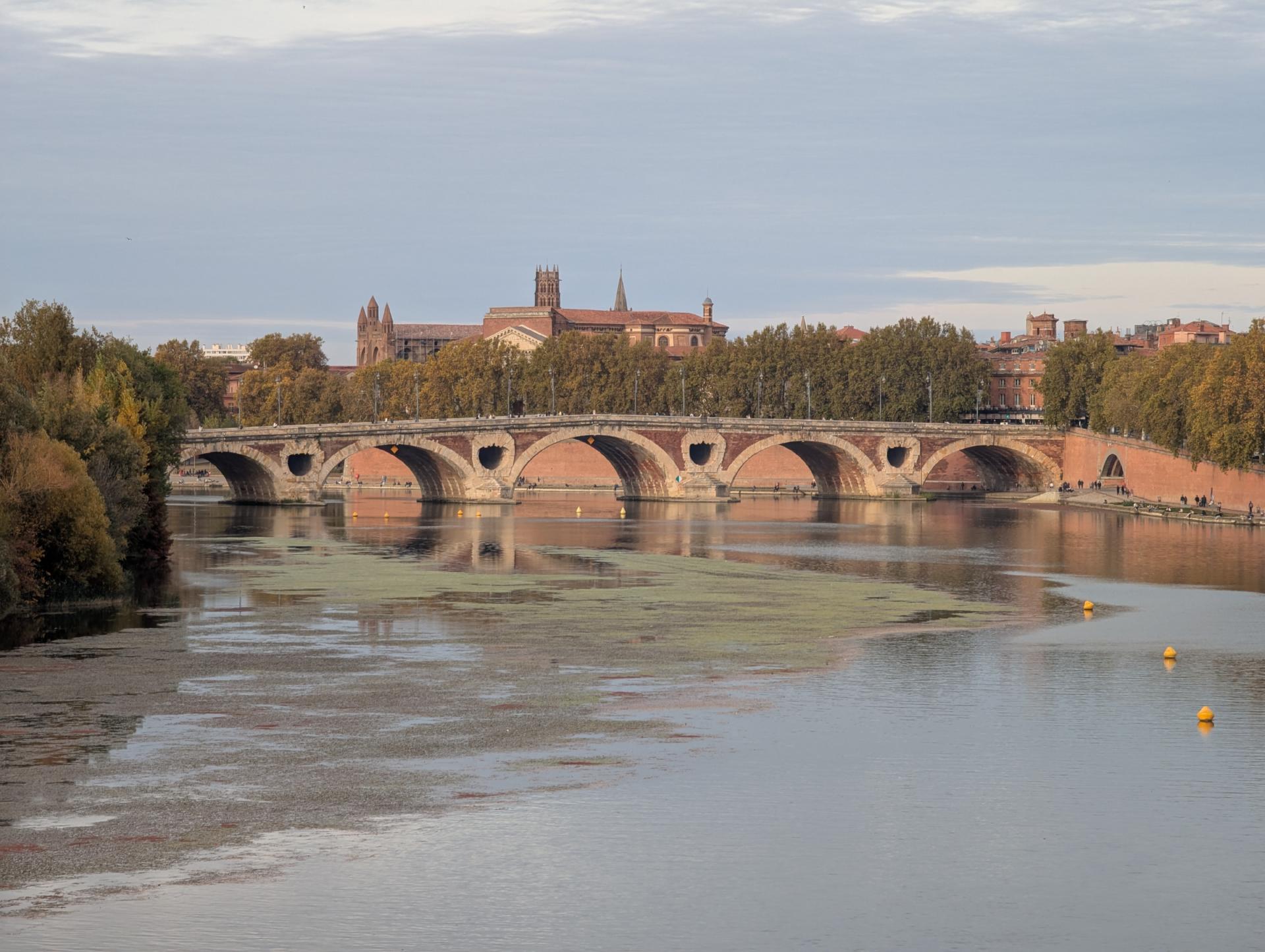
We keep walking, cross the Garonne at the Pont St Pierre and walk along the left bank admiring the river and reading the interpretive signs. B wants to head back along the Pont Neuf (like Paris, the “new” bridge is the oldest), but Alex insists that we walk through the autumn park beyond until we cross at Pont St Michel.


Walking in from the river, we encounter another church: Église Notre-Dame de la Dalbade de Toulouse. The pipe organ is being played inside the dim interior. I would be happy to sit and listen, but Alex finds it spooky.

I am not a religious person, but it is impossible not to be impressed and even engage in a degree of spiritual contemplation inside these churches. My ears cry out to hear music inside of them.
There are a couple of patisseries selling cakes near the Place des Carnes, good to know for tomorrow. We walk up looking for somewhere to eat. Many places are closed due to the public holiday, others aren’t opening for meals until 6.30 pm or 7.
Our legs are very tired and we know that once we return to the hotel we will not want to re-emerge, plus Alex wants Vietnamese food. Eventually we walk back up and towards the river to Quan Pho 83, a tiny shop run by a single Vietnamese aunty.

The phos and bun Bo are reasonable, but not exceptional, and Alex is still hungry afterwards, so they go to McDonald’s. It’s so sad.
At least we are staying in Toulouse for three nights, so we should have an opportunity to try the local cuisine. Plus, no need for any long distance railway journeys tomorrow!